
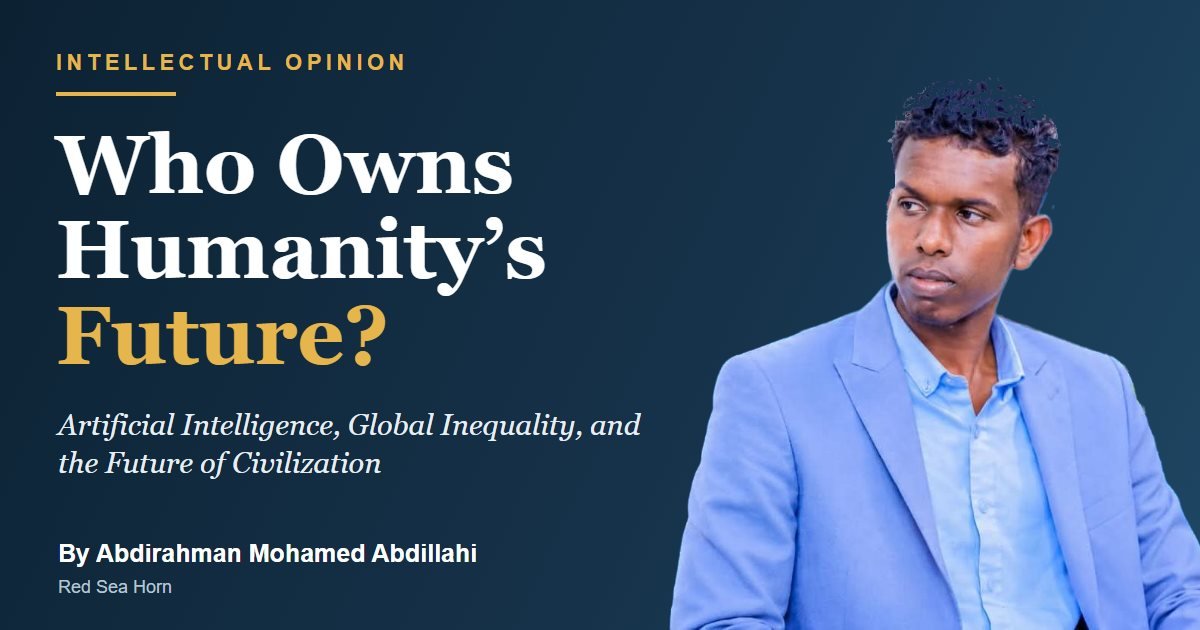
Intellectual Opinion
Artificial Intelligence, Global Inequality, and the Future of Civilization
By Abdirahman Mohamed Abdillahi | 7 November 2026
Introduction: The Most Important Question of Our Time
In January 2021, the government of the Netherlands fell. The cause was not a war or a financial crisis. It was a childcare benefit scandal. According to Amnesty International, racial profiling was built into an algorithmic system that flagged claims as potentially fraudulent, and tens of thousands of parents and caregivers, mostly from low-income families, were falsely accused of fraud as a result [1].
Two years later, a TIME investigation found that OpenAI had used outsourced Kenyan workers earning less than $2 per hour to help make ChatGPT less toxic. The outsourcing firm, Sama, gave a higher range of $1.46 to $3.74 per hour after taxes [2].
These two stories mark the two ends of the same problem. In one, citizens of a rich democracy could not challenge a machine’s suspicion. In the other, workers in a poorer country carried part of the hidden burden of a product designed and owned elsewhere. Neither story is science fiction, and neither depends on machines becoming superintelligent. Both are about power: who builds these systems, who answers for them, and who pays when they fail.
That is why the question in the title deserves a direct answer. Legally, no one owns humanity’s future. In practice, a small number of companies and governments now hold a growing share of the means of shaping it. For centuries, global power has been measured through territory, military strength, economic wealth, and political influence. Today, another source of power has joined them: control over computing infrastructure, data, algorithms, and the rules that govern them.
AI could still become one of humanity’s greatest achievements. The 2024 Nobel Prize in Chemistry recognized protein structure prediction, the work behind AlphaFold [3], which shows what these tools can do for science and medicine. But these benefits are not guaranteed to be shared fairly. The central challenge of our time is therefore not simply how to build more powerful technology. It is how to ensure that technological progress serves humanity as a whole rather than concentrating unprecedented power in the hands of a few.
1. The New Geography of Global Power
“Ownership” of AI is easier to understand when it is divided into four layers: the machines, the capital and models, the labor and data, and the rules. Each layer is concentrated, and each concentration reinforces the others.
The first layer is the machines. Oxford researchers found that the most powerful chips available for hire are concentrated in only about 30 countries, with the United States and China far ahead. Much of the world lies in what they call “Compute Deserts,” where no such chips can be rented at all [4].
The second layer is capital and models. Stanford’s AI Index reports that industry produced over 90 percent of notable frontier models in 2025, and that the United States produced 59 notable models that year against China’s 35 [5]. UNCTAD expects the AI market to reach $4.8 trillion by 2033, and it reports that just 100 firms, mainly in the United States and China, account for 40 percent of global corporate research and development spending [6].
The third layer is labor and data. The Kenyan case shows that the Global South is already inside the AI supply chain, but often at its lowest-paid point.
The fourth layer is the rules. UNCTAD reports that 118 countries, mostly in the Global South, are absent from major AI governance discussions [6]. Those who have the least say over the rules are also those with the least power to refuse the products.
This creates the possibility of a new hierarchy in international relations, determined not only by natural resources or military capabilities but also by technological ownership. Consider a world in which a small number of companies provide the systems used by governments, schools, hospitals, banks, and media organizations across several continents. Even without governing these societies, such companies could exercise considerable influence over their development.
This does not mean that technology companies seek political domination, and the danger does not come from companies alone. The Dutch scandal was the work of a state tax authority, not a corporation. Replacing corporate power with unchecked government power would solve nothing. The real issue is unaccountable power, whoever holds it.
2. Artificial Intelligence and the Future of Human Dignity
Technological progress should ultimately be judged by its contribution to human well-being. AI offers remarkable opportunities. Medical professionals can use AI-assisted tools to support diagnosis, teachers can reach new educational resources, and entrepreneurs can build services that once required substantial capital. For communities with little access to specialized expertise, these capabilities could be transformative.
However, these systems can also fail unequally. In the well-known “Gender Shades” study, researchers tested three commercial facial analysis systems and found error rates of up to 34.7 percent for darker-skinned women, while the maximum error rate for lighter-skinned men was 0.8 percent [7]. The machine was not malicious. It reflected what it had been built on and who had been left out, and the people least represented in its making paid the price.
What happens when an algorithm influences whether someone receives a job, a loan, public assistance, or access to an essential service? Who is responsible when an automated system makes a harmful decision? How can individuals challenge decisions made by systems they cannot understand? The Dutch parents faced exactly these questions, and for years they had no good answers.
The principle should be clear: technological efficiency cannot replace human dignity, and innovation cannot be an excuse for abandoning accountability. Human beings must not become passive subjects of systems that affect their lives without oversight.
The world does not lack principles. In November 2021, UNESCO’s 193 member states adopted the first global standard on AI ethics, emphasizing human rights, fairness, transparency, and human oversight [8]. But a recommendation is not a law. Principles must be translated into practical safeguards, working institutions, and a real path of appeal for the person harmed.
3. The Risk of a New Global Inequality
One of the greatest dangers of the AI revolution is that it could deepen existing inequalities between and within countries, and the starting line is already uneven. The International Telecommunication Union estimates that 2 billion people remain offline in 2026, and that only 32 percent of people in low-income countries use the internet [9]. A person who is offline cannot benefit from an AI tutor, however good it is. Yet that person’s country may still feel the economic effects of AI through trade, investment, and jobs.
The labor effects will also be uneven, though not in a simple way. The International Monetary Fund estimates that almost 40 percent of global employment is exposed to AI: about 60 percent of jobs in advanced economies, 40 percent in emerging markets, and 26 percent in low-income countries [10]. At first glance, this seems to favor poorer countries. The logic runs the other way. Exposure brings risk, but it also brings the chance of higher productivity. Countries with low exposure may be spared some disruption while also missing much of the gain, and so fall further behind.
There is also a physical cost. The International Energy Agency reports that data centers used about 415 terawatt-hours of electricity in 2024, around 1.5 percent of the world’s total, and it expects that to more than double to around 945 terawatt-hours by 2030 [11]. Countries that struggle to keep hospitals and schools supplied with electricity cannot easily compete for this infrastructure.
This raises a critical distinction: access to technology is not the same as the capacity to shape it. A country may use advanced AI applications without having the infrastructure, expertise, or institutional influence needed to decide how they are designed and governed. A hospital in Nairobi or Mogadishu that uses a diagnostic tool trained elsewhere has access. It does not have control, and it may not know how well the tool works for its own patients.
Developing countries are not simply waiting for help. In July 2024, the African Union’s Executive Council endorsed a Continental AI Strategy [12]. A fair technological future requires more than distributing software. It requires investment in education, local research, digital infrastructure, entrepreneurship, and scientific cooperation, so that developing countries become participants in the technological revolution and not merely markets for products created elsewhere.
4. Can Global Institutions Protect Humanity’s Future?
Technological challenges cross borders. Data flows between jurisdictions, digital platforms operate internationally, and AI systems affect people far beyond the countries where they are developed. No single government can address this alone, and the institutions to do so are being built. The United Nations adopted the Global Digital Compact in September 2024 [13]. On 26 August 2025, the General Assembly established an Independent International Scientific Panel on AI and a Global Dialogue on AI Governance [14]. The Panel has 40 members from all five UN regions [15], and delegations from 163 countries took part in the first Dialogue in Geneva in July 2026 [16]. The Council of Europe’s Framework Convention on AI was signed in Vilnius in September 2024 [17].
This is real progress, and it should not be dismissed. But honest analysis requires three cautions.
First, participation is not power. A seat in Geneva does not give a country chips, capital, or scientists, and the countries that do hold them have little reason to give up their advantage. The states leading in AI see it as a matter of national security and economic competition. Any plan that depends on their generosity alone will fail.
Second, the UN can advise and convene, but it cannot enforce. Real enforcement lies with those who control market access and public budgets.
Third, even the strongest regulator moves slowly. The European Union’s AI Act entered into force on 1 August 2024, yet the rules for high-risk systems have since been postponed to December 2027 and August 2028 [18]. If the European Union, with all its legal capacity, needs this long, then a poorer state cannot wait for the perfect law. Nor should anyone assume that the technology will wait.
A fair objection deserves an answer: will regulation slow innovation and only protect the largest firms, which can afford lawyers and audits? It can, if it is badly designed. This is why rules should be strictest where the risk to people is highest, and lightest for small developers and low-risk uses. The objective is not to prevent innovation. It is to ensure that innovation develops within a framework that protects people and distributes opportunities more fairly.
5. A Proposal: A Global Compact for Human-Centred AI
A proposal is only useful if it says who must act and what can be measured. The next meeting of the Global Dialogue, in New York on 3–4 May 2027 [16], offers a natural deadline. The international community should advance a practical framework built around five priorities.
First, use public purchasing as enforcement.
Governments are among the largest buyers of technology, and they need no treaty to set conditions on what they buy. Any system used for welfare, policing, health, or hiring should require an independent assessment, human oversight, and a clear right of appeal for the people it affects. A small state cannot rewrite a global company’s code, but it can decline to sign the contract, and regional groups such as the African Union can do so with far greater weight. The Dutch case shows why this must apply to governments themselves.
Second, make access to computing a shared goal.
Countries in “Compute Deserts” can pool demand through regional facilities and research partnerships. International funders should finance computing resources, technical education, and reliable electricity together, because one is of little use without the others. Any global funding mechanism should operate transparently and prioritize communities with the greatest barriers to participation.
Third, give developing countries a voice with evidence behind it.
The Scientific Panel should publish an annual public measure of the global AI divide, covering computing capacity, connectivity, research, and participation in governance, broken down by region. What is measured every year is harder to ignore. Support for researchers, universities, and civil society in underrepresented regions would give those voices the data to argue from.
Fourth, protect the workers behind the machine, and prepare those ahead of it.
Companies that buy data-labeling and content moderation services should publish basic standards on pay and mental health support across their supply chains. Governments, educational institutions, and employers should invest in reskilling, lifelong learning, and social protection, and should not assume that technological growth automatically benefits everyone.
Fifth, protect future generations.
Decisions about powerful technologies should consider long-term consequences, including security risks, environmental costs, human autonomy, and the rights of children. Publishing the energy and water use of large AI facilities would be a simple first step.
These priorities can be advanced through existing institutions, including the Global Digital Compact and its mechanisms for scientific assessment and dialogue. They do not ask powerful states to act against their interests all at once. They begin with what buyers, regions, and publics can do now, and this creates pressure for more.
6. Humanity Must Remain the Author of Its Future
The debate about AI is often framed as a contest between technological optimism and technological fear. This framing is incomplete. The more important question is whether humanity can build institutions capable of directing technological progress toward shared goals.
AI is not a substitute for political judgment, moral responsibility, or collective decision-making. Its consequences depend on the choices made by governments, companies, researchers, communities, and individuals. If societies prioritize only commercial advantage and geopolitical competition, the benefits of AI will likely become more concentrated. If they invest in cooperation, accountability, education, and equitable access, AI could expand human capabilities on an unprecedented scale.
Neither outcome is inevitable. The future will be shaped by decisions made in the present: which technologies are funded, which risks are tolerated, whose voices are heard, and which principles guide the institutions responsible for governance.
This is why AI governance should not remain an exclusive conversation among technology executives, powerful governments, and technical experts. The Dutch parents and the Kenyan workers were not in the room when the systems that shaped their lives were designed. Citizens, educators, young people, entrepreneurs, and communities in every region deserve a place in that discussion.
Conclusion: The Future Must Belong to Humanity
The defining question of the twenty-first century may not be whether machines will become more intelligent, but whether human institutions will become wise enough to govern the technologies they create.
A world with extraordinary technological capabilities but deepening inequality, weak accountability, and concentrated power cannot be considered a success. Progress must mean more than faster computers, larger economies, and more sophisticated algorithms. It must also mean greater opportunity, stronger human rights, and technological achievements that improve lives across national and social boundaries.
No one owns humanity’s future yet. But ownership can be established quietly, through contracts signed, standards set, and infrastructure built, long before any public debate takes place. No country can solve this alone, and no company or government should shape humanity’s technological future without accountability to those it affects.
We must decide whether technology will serve humanity, or whether humanity will increasingly be expected to serve the systems it creates.
That decision cannot be left to the future. It begins with the choices we make today.
References
1. Amnesty International (25 October 2021). Dutch childcare benefit scandal an urgent wake-up call to ban racist algorithms. https://www.amnesty.org/en/latest/news/2021/10/xenophobic-machines-dutch-child-benefit-scandal/
2. Perrigo, B. (18 January 2023). OpenAI Used Kenyan Workers on Less Than $2 Per Hour. TIME. https://time.com/6247678/openai-chatgpt-kenya-workers/
3. Wikipedia. AlphaFold (2024 Nobel Prize in Chemistry). https://en.wikipedia.org/wiki/AlphaFold
4. Perrigo, B. (28 August 2024). New Research Finds Stark Global Divide in Ownership of Powerful AI Chips. TIME. https://time.com/7015330/ai-chips-us-china-ownership-research
5. Stanford HAI (2026). The 2026 AI Index Report. https://hai.stanford.edu/ai-index/2026-ai-index-report
6. UNCTAD (7 April 2025). AI’s $4.8 trillion future: UN Trade and Development alerts on divides, urges action. https://unctad.org/press-material/ais-48-trillion-future-un-trade-and-development-alerts-divides-urges-action
7. Buolamwini, J. and Gebru, T. (2018). Gender Shades. Proceedings of Machine Learning Research, 81, 77–91. https://proceedings.mlr.press/v81/buolamwini18a.html
8. UNESCO. Recommendation on the Ethics of Artificial Intelligence. https://www.unesco.org/en/artificial-intelligence/recommendation-ethics
9. International Telecommunication Union (2026). Facts and Figures 2026. https://www.itu.int/en/ITU-D/Statistics/Pages/facts/default.aspx
10. Georgieva, K. (14 January 2024). AI Will Transform the Global Economy. Let’s Make Sure It Benefits Humanity. IMF. https://www.imf.org/en/Blogs/Articles/2024/01/14/ai-will-transform-the-global-economy-lets-make-sure-it-benefits-humanity
11. International Energy Agency (2025). Energy and AI: Executive Summary. https://www.iea.org/reports/energy-and-ai/executive-summary
12. African Union (2024). Continental Artificial Intelligence Strategy. https://au.int/en/documents/20240809/continental-artificial-intelligence-strategy
13. United Nations. Global Digital Compact. https://www.un.org/digital-emerging-technologies/global-digital-compact
14. United Nations. Independent International Scientific Panel on AI and Global Dialogue on AI Governance. https://www.un.org/global-digital-compact/en/ai
15. United Nations. Independent International Scientific Panel on AI: Panel Members. https://www.un.org/independent-international-scientific-panel-ai/en/panel-members
16. United Nations. Global Dialogue on AI Governance. https://www.un.org/global-dialogue-ai-governance/en
17. Wikipedia. Framework Convention on Artificial Intelligence (Council of Europe). https://en.wikipedia.org/wiki/Framework_Convention_on_Artificial_Intelligence
18. European Commission (updated 19 October 2026). AI Act: Regulatory framework for AI. https://digital-strategy.ec.europa.eu/en/policies/regulatory-framework-ai

Abdirahman Mohamed Abdillahi
Author. The views in the Intellectual Opinion column are those of each author.
© 2026 Abdirahman Mohamed Abdillahi. All rights reserved.