
Horn of Africa Weekly Update · Issue No. 15
Nexa Insight · Horn of Africa Weekly Update
Reference: NRTC/HAWU/2026-15 | Coverage: 28 October – 1 November 2026, with 18–27 October background where it explains the week | Published: 1 November 2026
This week
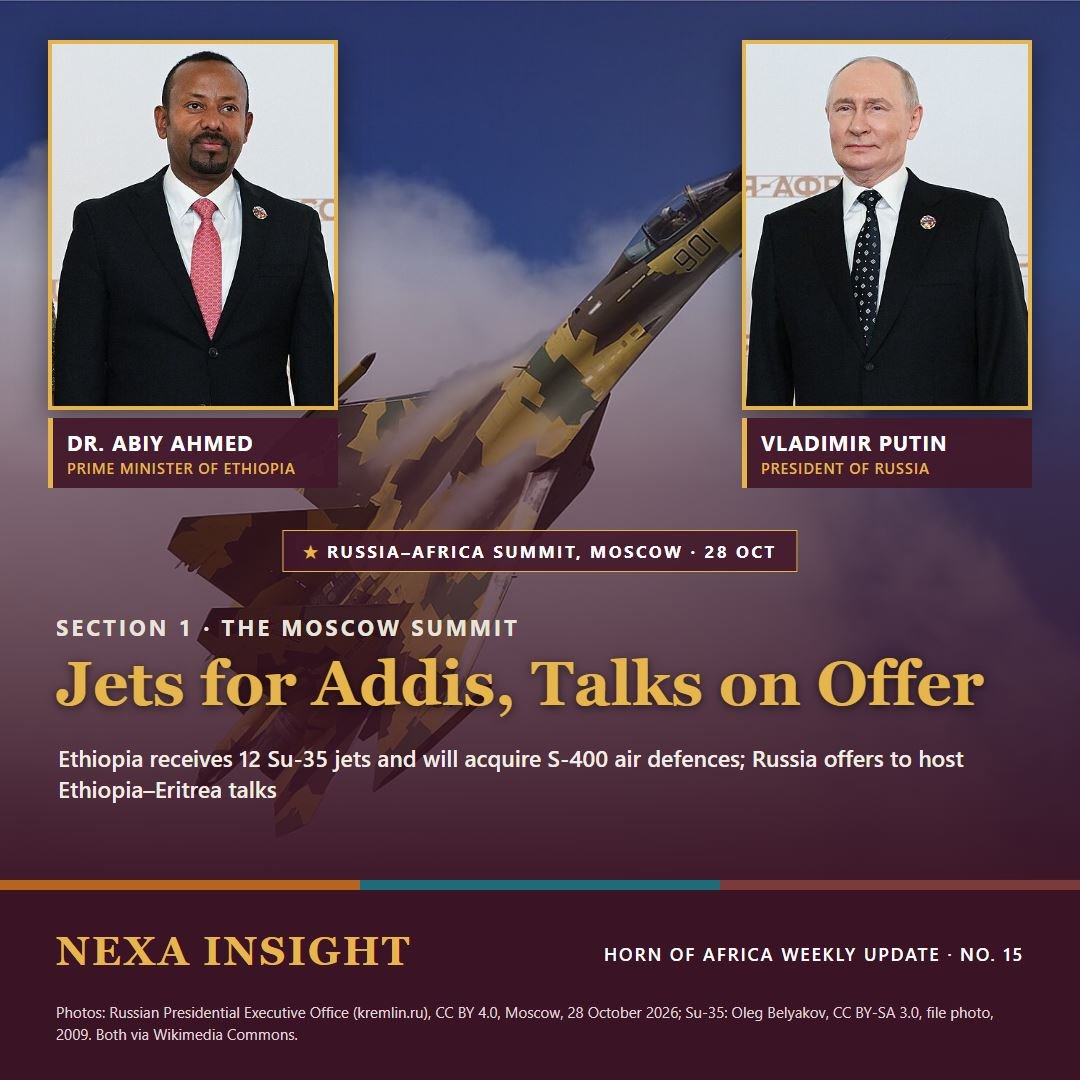
Moscow was the centre of Horn of Africa politics this week. At the Russia–Africa summit, Dr. Abiy Ahmed announced that Ethiopia has received 12 Russian Su-35 fighter jets and will acquire S-400 air defence systems. Russia repeated its offer to host talks between Ethiopia and Eritrea, and President Putin held separate talks with President Isaias Afwerki. No meeting between the two Horn leaders was reported. On the same day as the jets announcement, Sudan’s government accused Ethiopia of allowing drone attacks on Sudan from its territory, a charge Ethiopia has rejected in the past. Inside Ethiopia, a flag dispute at Moyale between the Somali and Oromia regions led up to an estimated 50,000 people to cross into Kenya, according to UNHCR citing local authorities, while fighting continued in central Tigray.
1. The Moscow summit: Russian jets for Ethiopia, and Russia’s offer to both sides
KEY EVENTS THIS WEEK
- 27 Oct: President Isaias Afwerki arrives in Moscow for the Third Russia–Africa Summit.
- 28 Oct: Dr. Abiy Ahmed arrives in Moscow, meets President Putin at the Kremlin, and announces that Ethiopia has received 12 Su-35 fighter jets and will acquire four S-400 air defence batteries.
- 28 Oct: Foreign Minister Sergey Lavrov repeats Russia’s offer to host Ethiopia–Eritrea talks if both sides show interest.
- 30 Oct: President Isaias holds talks with President Putin at the Kremlin.
What happened: On 28 October, Dr. Abiy announced on X that Ethiopia had received 12 Su-35 fighter jets from Russia, a year earlier than planned under an existing agreement, and that four S-400 air defence batteries would follow. He gave no delivery date for the S-400s. He said the equipment would strengthen Ethiopia’s ability to “preemptively deter aggression” and thanked President Putin for speeding up the delivery (Al Jazeera, 28 October). At their meeting in the Grand Kremlin Palace, President Putin said: “I value the friendly relations between Russia and Ethiopia,” and “Russia and Ethiopia stand together in international affairs.” He said trade between the two countries in January–September was more than $1.3 billion, over twice the figure for all of 2025 (Al Jazeera, 29 October).
On the same day, Foreign Minister Lavrov said Moscow was ready to help restore relations between Ethiopia and Eritrea: “If they show interest; whether now, tomorrow, or the day after tomorrow,” he said, “Russia will strive to host and facilitate the meeting” (Addis Standard, via allAfrica). Neither government publicly accepted the offer.
President Isaias, who arrived on 27 October, held talks with President Putin at the Kremlin on the evening of 30 October, followed by a closed meeting. According to Eritrea’s Ministry of Information, Putin spoke of “the alignment of positions of both countries on several critical issues” and of closer cooperation in energy, technology, mining, agriculture and food security. The Eritrean account does not mention Ethiopia (Shabait). Nexa Insight found no report of a meeting between Dr. Abiy and President Isaias by 1 November.
Analysis: Russia kept good relations with both sides in Moscow. Ethiopia received the most visible result: modern fighter aircraft delivered early and a promise of long-range air defence. Eritrea received a full Kremlin meeting and Russian words of political alignment. Russia offered itself as a host for talks, but neither government accepted.
The arms deal changes the military balance in the region. Benedict Manzin, an analyst at Sibylline, told Al Jazeera that the S-400 systems “would be best used against conventional air threats,” and that “in a war with Eritrea, they could be used against Eritrea’s limited air force and drones.” Addis Ababa presents the equipment as deterrence. For Asmara, the same equipment is a change in Ethiopia’s capability on its border. For outside powers, the summit showed that Moscow is now an active player in the Ethiopia–Eritrea question, alongside Washington.
Effects: For security, Ethiopia’s air power grows while tensions with Eritrea remain high. For diplomacy, Russia’s offer stays open, but there was no public contact between the two leaders. For outside powers, Moscow’s close ties with both capitals give it a channel others lack.
2. Ethiopia and Sudan: Khartoum’s drone charges
KEY EVENTS THIS WEEK
- Week to 28 Oct: Sudanese officials say Sudan’s power grid was attacked by drones seven times in one week.
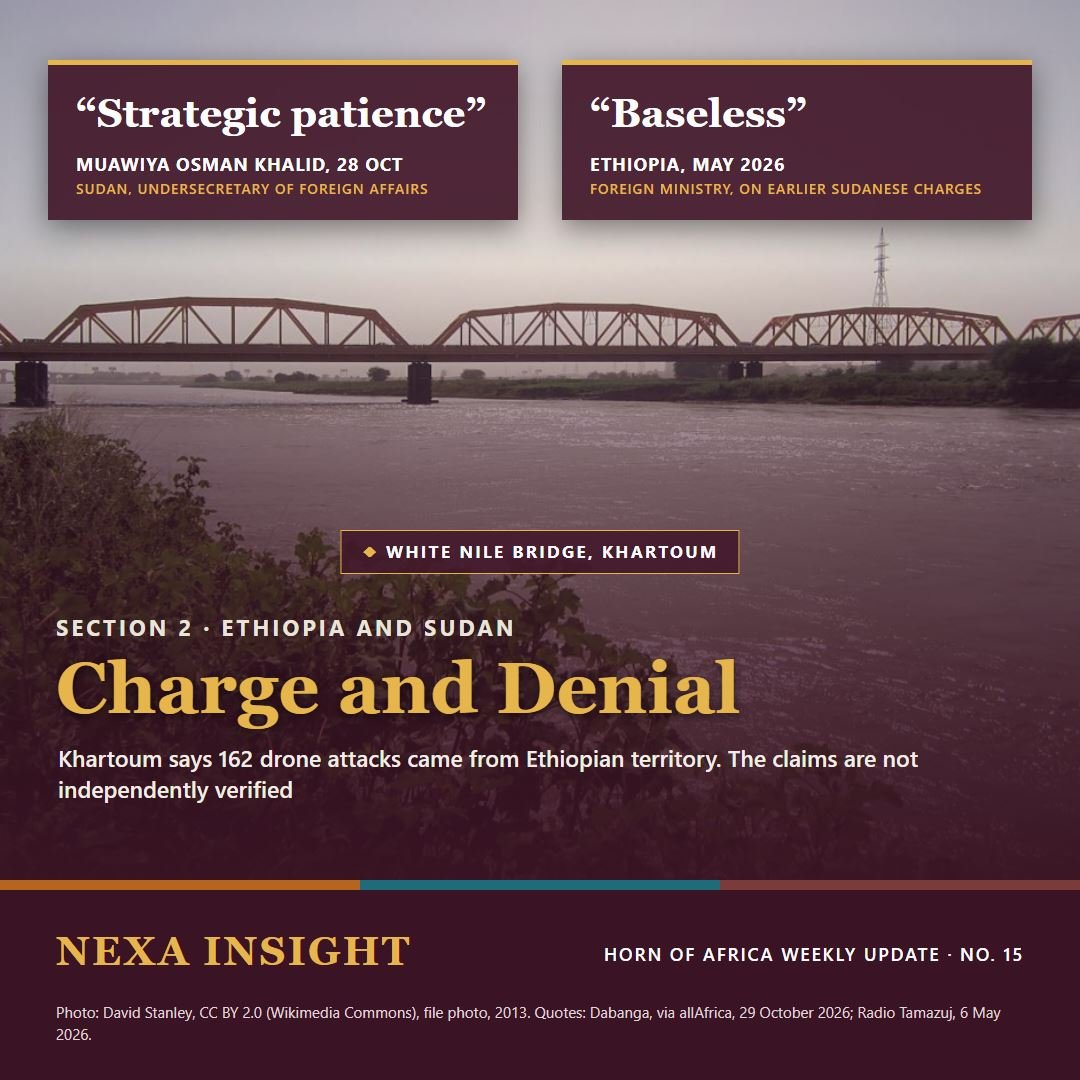
- 28 Oct: At a news conference in Khartoum, Sudan’s government accuses Ethiopia of allowing drone attacks to be launched from its territory. It puts the total at 162 attacks and calls for an international response. The figures have not been independently verified.
What happened: On 28 October, officials from Sudan’s defence, foreign affairs and information ministries and the General Intelligence Service said drones that struck Sudanese power and civilian sites had been launched from Ethiopia, including from Bahir Dar Airport (Radio Tamazuj). They said “162 drone attacks launched from Ethiopian territory have killed more than 400 civilians and 102 military personnel,” and named Assosa, Bahir Dar and sites along the border as launch points (Dabanga, via allAfrica). Undersecretary of Foreign Affairs Muawiya Osman Khalid called on the international community not to overlook what he described as “Ethiopian-Emirati aggression against Sudan,” and said Sudan was following a policy of “strategic patience” (Radio Tamazuj; Dabanga). Radio Tamazuj said it could not independently verify the evidence, and that the Ethiopian government could not be reached for comment.
Ethiopia rejected a similar accusation in May 2026. Its Ministry of Foreign Affairs called Sudan’s claims “baseless” and said: “In recognition of the fraternal ties between the two nations, the Ethiopian government has exercised restraint” (Radio Tamazuj, 6 May). In the same statement, Ethiopia said the Sudanese Armed Forces had “provided arms and financial support” to TPLF fighters crossing its western frontier (Al-Monitor, 5 May). Nexa Insight found no new Ethiopian statement on the 28 October charges by 1 November.
Analysis: The two governments now accuse each other of the same thing: allowing their territory to be used against the other. Neither side’s claims have been independently verified. Sudan’s charge came on the day Dr. Abiy announced the Russian jets, and it adds a western front to the pressures Ethiopia faces in the north. For Khartoum, naming Ethiopia and the UAE together turns a battlefield problem into a diplomatic case aimed at the international community. For Addis Ababa, the issue is whether the charge stays a war of words or reaches the African Union or the UN Security Council.
Effects: For security, the Ethiopia–Sudan border is now a second area of tension next to the Eritrean border. For diplomacy, Sudan’s call for an international response may bring the charge before regional or UN bodies. Ethiopia’s formal reply is the next thing to watch.
3. Inside Ethiopia: a flag dispute at Moyale, and fighting in central Tigray
KEY EVENTS THIS WEEK
- 18 Oct (background): The Somali Regional State opens an administration office and raises its regional flag in a disputed part of Moyale. A 13-year-old girl is killed in the clash that follows.
- 22–27 Oct (background): Fighting between Somali and Oromia regional forces spreads from Moyale to Arero and Wachile districts.
- 26 Oct: Federal forces capture at least seven commanders of the Tigray Defence Forces (TDF), including General Yohannis Woldegeyorgies (John Medid), in central Tigray, according to the ACLED conflict monitor.
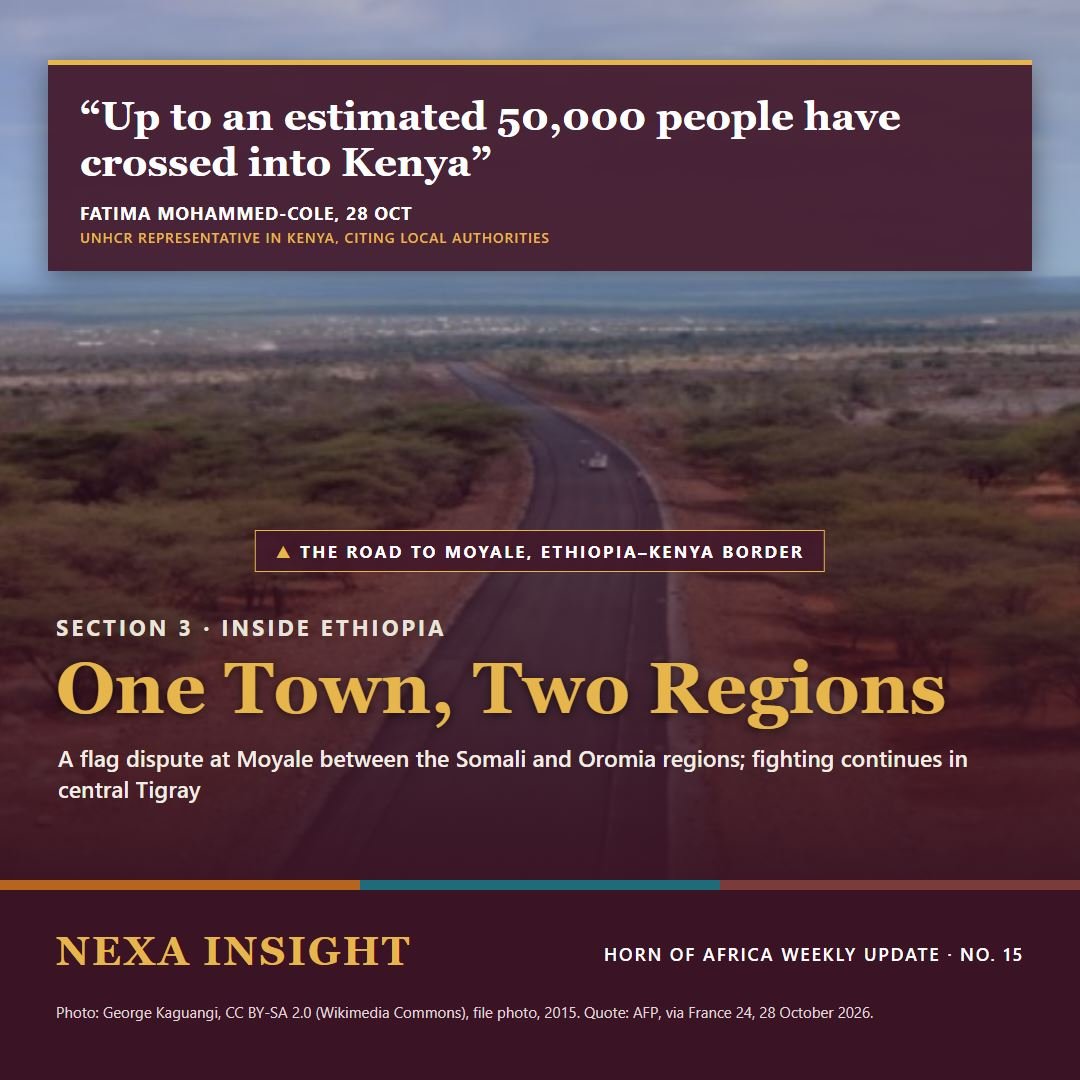
- 28 Oct: UNHCR says up to 50,000 people have crossed into Kenya. ACLED reports that the clashes appear to have subsided, but tension remains high.
What happened: Moyale, on the Kenyan border, is divided between Ethiopia’s Somali and Oromia regions. The violence began after the Somali Regional State opened an office and raised its flag in a disputed locality on 18 October (ACLED). A 13-year-old girl was killed. Elders and security forces from both sides agreed on 19 October to remove the flag and halt the opening of the office, but clashes resumed on 22 October and spread to other districts (ACLED). Each side blames the other. An Oromia town official called it “a war declared on our people early in the morning by forces who have recently been making various provocations.” A Somali resident who fled to Kenya said: “it was forces from the Borana side who opened fire on us; they prevented us from raising our flag” (Eastleigh Voice). ACLED links the clashes to a historical boundary dispute between the Borana (Oromo) and Garre (Somali) communities. AFP could not independently verify the death toll.
On 28 October, UNHCR’s representative in Kenya, Fatima Mohammed-Cole, said: “According to local authorities, up to an estimated 50,000 people have crossed into Kenya.” The figure had been 36,000 a day earlier (AFP, via France 24).
In Tigray, fighting continued in the central zone. ACLED recorded that federal forces and their allies encircled and captured at least seven TDF commanders, including General Yohannis Woldegeyorgies, and 18 colonels in Simeret on 26 October, and that federal and TDF forces clashed in Kola Tembien on 29 October. Nexa Insight found no confirmation from a news agency. The six-month caretaker administration appointed by Addis Ababa remains in place, but the fighting has not stopped (Al Jazeera).
Analysis: The Moyale dispute is a contest over administrative control: which region runs the town, and whose flag flies there. Both regions are part of Ethiopia’s federal system. The federal government now faces a dispute between two of its own regions at the same time as its campaign in Tigray and its tensions with Eritrea and Sudan. In Tigray, the capture of senior commanders, if confirmed, would weaken the Tigrayan forces’ ability to fight on, which supports the federal side’s push for disarmament.
Effects: For Kenya, the arrivals at Moyale are now a humanitarian task shared with UNHCR and the Red Cross. For Ethiopia, the Moyale dispute is a test of federal mediation between the regions. For Tigray, the response of remaining Tigrayan units after the loss of senior commanders will show whether the fighting is winding down.
Key points for regional decision-makers
- On Moscow: Read the Su-35 and S-400 deal as a lasting change in Ethiopia’s air power. Russia’s offer to host Ethiopia–Eritrea talks remains open; any acceptance would be the first public sign of contact.
- On Ethiopia and Sudan: Watch for Ethiopia’s formal reply and for any move by Sudan to take its charges to the African Union or the UN Security Council.
- On Moyale: The return of displaced people from Kenya depends on a federal-brokered settlement between the two regions on the town’s administration.
- On Somaliland: Nexa Insight found no major new political development this week. Under the rules announced on 25 October, from 1 November airlines may sell tickets for flights from Hargeisa and Berbera only through agents that meet Somaliland’s licensing rules (Horn Diplomat; see Issue 14).
Bottom line
This week, the Horn’s politics moved to Moscow. Russia armed Ethiopia, welcomed Eritrea, and offered to host both, but the two leaders did not meet in public. Sudan’s drone charges added a western dimension to Ethiopia’s security picture, and the Moyale dispute added an internal one. In the next issue, we will follow whether Ethiopia and Eritrea take up Russia’s offer, Ethiopia’s reply to Sudan, and federal efforts to settle the Moyale dispute.
References
Al Jazeera (2026). Ethiopia receives 12 Russian Su-35 jets, plans S-400 acquisition, 28 October. aljazeera.com
Al Jazeera (2026). Why is Russia sending fighter jets and air defences to Ethiopia?, 29 October. aljazeera.com
Addis Standard, via allAfrica (2026). Russia Repeats Offer to Host Ethiopia–Eritrea Dialogue, PM Abiy Arrives in Moscow for Africa Summit, 28 October. allafrica.com
Shabait, Eritrea Ministry of Information (2026). President Isaias Afwerki arrives in Moscow, 27 October. shabait.com
Shabait, Eritrea Ministry of Information (2026). President Isaias Afwerki holds talks with President Vladimir Putin, 31 October. shabait.com
Radio Tamazuj (2026). Sudan accuses Ethiopia of involvement in drone strikes on infrastructure, 28 October. radiotamazuj.org
Dabanga, via allAfrica (2026). Sudan Accuses Ethiopia of Launching 162 Drone Attacks From Its Territory, 29 October. allafrica.com
Radio Tamazuj (2026). Ethiopia rejects Sudan drone strike accusations, tensions rise, 6 May. radiotamazuj.org
Al-Monitor (2026). Ethiopia rejects Sudan’s strike claims, accuses Khartoum of backing Tigray rebels, 5 May. al-monitor.com
ACLED (2026). Where in Ethiopia did a regional flag spark deadly clashes?, 29 October. acleddata.com
ACLED (2026). Conflict in Ethiopia: alerts, 26–30 October. acleddata.com
Agence France-Presse, via Arab News (2026). Several dead in clashes between rival Ethiopia regional armies, 24 October. arabnews.com
Agence France-Presse, via France 24 (2026). Ethiopia clashes push 50,000 to flee to Kenya, 28 October. france24.com
Eastleigh Voice (2026). Flag dispute sparks deadly clashes between Oromia and Somali forces in Ethiopia’s Moyale, 22 October. eastleighvoice.co.ke
Horn Diplomat (2026). Somaliland Bars Tickets Issued Through Somalia’s BSP, 25 October. horndiplomat.com
Abdinasir Hassan Timoweyne is a political analyst, Founder and Director of the Nexa Centre, and Senior Lecturer in International Relations at New Generation University. He is the author of several published articles on Horn of Africa and Middle East politics.