
Nexa Insight · Political Analysis
By Abdinasir Hassan Timoweyne, Political Analyst | 7 November 2026
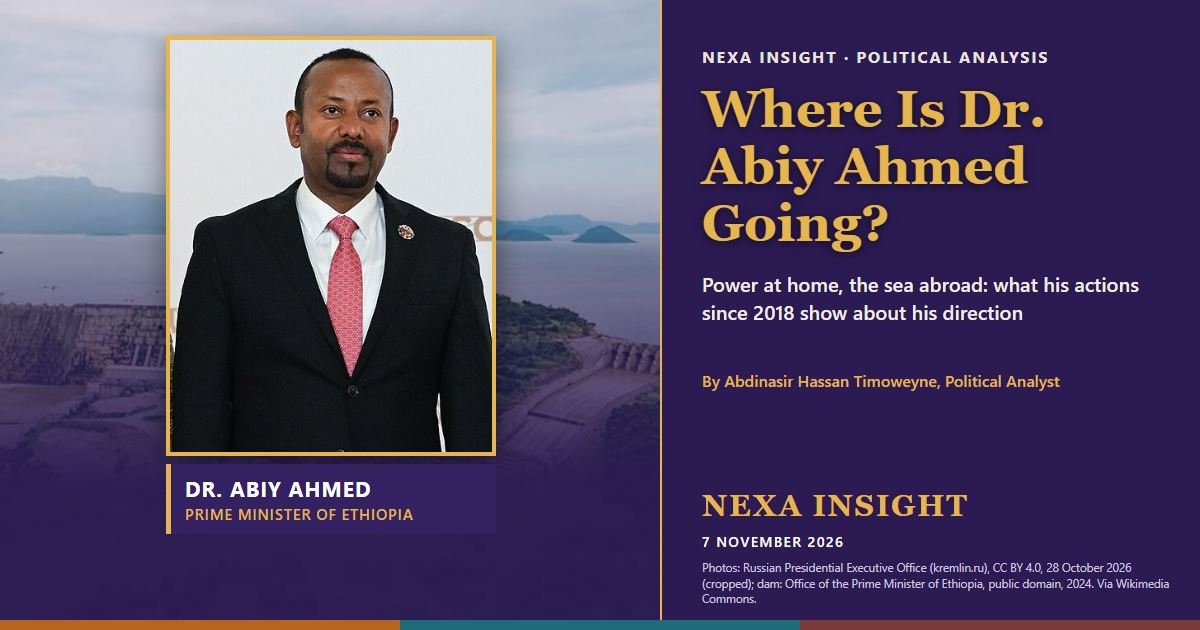
A leader’s intentions are hard to prove. His speeches can change, and his private thoughts are closed to us. His actions over time are better evidence, because they show what he is willing to pay for. Read this way, the record of Dr. Abiy Ahmed since 2018 is not a set of unconnected surprises. It shows a consistent direction: a stronger centre at home, no armed rival to that centre, and a change in Ethiopia’s position from a landlocked state to a Red Sea power.
The actions, and what each one serves
Diplomacy first (2018–2019). Dr. Abiy opened with peace. The Nobel Committee honoured “his decisive initiative to resolve the border conflict with neighbouring Eritrea.” Yet in the same period he announced that Ethiopia would rebuild its navy (ADISS, 2026). Even at the height of the peace, the sea was on the agenda.
One party, one centre (December 2019). He dissolved the old ruling coalition and, in the words of the scholar Terje Østebø, established “the new and centralised Prosperity Party” (Østebø, 2025). This replaced a coalition of ethnic parties with a single national organisation. In June 2026, the party won 438 of the 547 seats in parliament (TVC News/AFP), and on 5 October he began a second five-year term. Voting did not take place in Tigray or in some constituencies of other regions (Wikipedia, citing NEBE and agencies).
Ending the rival centre of armed power (2020–2026). The Tigray People’s Liberation Front (TPLF) was the dominant party in Ethiopia’s ruling coalition until 2018 (CRS, 2026). The 2022 Pretoria agreement stopped the first war but did not settle the question of power. After fighting resumed, joint federal and allied operations forced the TPLF out of Mekelle in early October 2026, and a caretaker administration was appointed (CRS, 2026). “The TPLF did not exist 50 years ago, and now its existence is coming to an end,” Dr. Abiy said on 19 October (AFP). This is the stated aim, but it is not yet the result. The TPLF rejects the caretaker authority and still claims battles, most recently near Aksum.
Making the sea a national question (2023 onward). In a televised speech on 13 October 2023, he said: “Ethiopia’s existence as a nation is linked to the Red Sea” (Africanews/AFP). The material interest is real: most of Ethiopia’s trade passes through Djibouti, at a reported cost of about $1.5 billion a year (AP, 2026). In January 2024, he signed the memorandum of understanding with Somaliland, a route based on an agreed port and sea-access partnership. It remains the clearest example of access through negotiation between two willing parties. Mogadishu objected, and Turkey then mediated between Ethiopia and Somalia (CRS, 2026).
Building the instruments (2025–2026). A naval headquarters was inaugurated in September 2025 (ADISS, 2026). Russia agreed to help with naval training (Maritime Executive, 2025). The navy’s commander now reports “marine commando battalions,” and a first cohort of sailors in training at Bishoftu, in a force built “from scratch” (Addis Standard, 2026). No country builds marines for a coast it never expects to reach. In Moscow in October 2026, he announced Su-35 fighter jets and four S-400 air defence batteries. Rosoboronexport says the first batch was two aircraft, but the direction is clear.
Symbols of national rise. He opened the Grand Ethiopian Renaissance Dam in September 2025, saying it would “change the history of black people” and was “absolutely not to harm its brothers” (The Guardian). The dam is an economic asset and also proof that Ethiopia can finish a great project against a powerful neighbour’s objections.
Disciplining the state itself (October 2026). At the Hurso centre, he put ministers and senior officials through military training, and joined them. “Soldiers have targets while civilians have goals. The objective of both is victory,” he said (BBC). His stated purpose is discipline and leadership. One critic argues that it builds an obedient elite (Hanna, Borkena, 2026). Either way, the act matters: the civilian government is being prepared for a long contest.
Is he preparing to be a king?
The question is not invented. Dr. Abiy himself has told the story that his mother prophesied he would become Ethiopia’s seventh king (Africa Confidential, 2023; Østebø, 2025). Østebø reads this within his religious worldview, as a claim of divine selection. It tells us how he may understand his own mission.
But the constitutional evidence points elsewhere. No proposal for a monarchy exists. What exists is a National Dialogue package of about 400 recommendations, and Dr. Abiy has confirmed that amendments will follow. The proposals include a possible move to a presidential system with “a single, non-renewable six-year executive term,” and a change to Article 39 on self-determination (Capital, 2026). These are still proposals, not law. Today, as Alemayehu Fentaw Weldemariam notes, the constitution sets no limit on a prime minister’s terms (The Conversation, 2026).
So “king” is a useful image but a poor description. The more accurate term is a strong executive, built on a dominant party and a more unitary state. The test is simple: whether the term limit is adopted, how many terms it allows, and whether it applies to him.
Does he want to expand Ethiopia’s territory?
Here the evidence divides, and both sides must be heard. Eritrea reads the record as a plan to take Assab. Its Ministry of Information has published statements it attributes to Ethiopian officials, including “by force if necessary” (Shabait, 2026), though without dates. The Congressional Research Service notes military parades “hinting at an ambition to reclaim Eritrea’s port of Assab.”
Dr. Abiy’s recorded words say otherwise. In March 2026, he said: “Ethiopia will not fire a single bullet at Eritrea, Somalia, Djibouti or Kenya. We do not question their sovereignty” (AP). In October 2026, he spoke of “the principle of give and take” (Al Jazeera). And Ethiopia has its own charge: that Eritrea, Egypt and Sudan are backing its rebels, which they deny.
The most careful reading is that his aim is the sea, not land for its own sake. He wants access that Ethiopia controls, not access it merely rents. The route he prefers is an agreement, and the armed forces serve to make that agreement more likely. A state with a navy, modern jets and long-range air defence bargains from a stronger position than a state without them. This is coercive bargaining, not yet conquest.
The danger lies in how neighbours read it. Each step that Addis Ababa calls deterrence, Asmara calls preparation for war, and each side’s precautions confirm the other’s fears. Egypt, Eritrea, Somalia and Sudan have already met and declared that Red Sea governance is the exclusive responsibility of its coastal states (Al Jazeera, 2026). Bargaining of this kind can turn into the war that neither side says it wants.
Where he is going
Dr. Abiy is pursuing regional primacy for Ethiopia through a stronger state, with himself at its centre. Throne and conquest are both too simple as labels. The record is that of a leader who believes a nation of Ethiopia’s size cannot accept its present place, and who is building the means to change it.
His limits are also real. Fighting continues in parts of Tigray, Amhara, Oromia and Benishangul-Gumuz (CRS, 2026). Relations with Eritrea are cut, and consulates with Sudan are closed. Benedict Manzin of the Sibylline consultancy warns that conventional air defence systems “can be overwhelmed by small, cheap drones” (Al Jazeera, 2026). Three signs will show which path he takes: the wording of the constitutional amendments, whether federal authority in Tigray becomes a political settlement, and whether sea access comes through a signed agreement or through force. The first two will tell us about the state he is building. The third will tell us about the region.
References
Addis Standard, via allAfrica (2026). Ethiopia Navy Expanding ‘Robust Capabilities’, 16 October.
ADISS Editorial Desk (2026). Ethiopia’s Navy Sets to Sail Again, 17 September.
Africa Confidential (2023). An imperial palace in the Yeka hills, Vol 64 No 14.
Africanews with AFP (2023). Red Sea: Ethiopia “will not assert its interests through war”, assures Abiy Ahmed, October.
AFP, via France 24 (2026). Ethiopia PM warns Eritrea of ‘severe consequences’ if supports enemies, 19 October.
Al Jazeera (2026). Ethiopian PM Abiy demands Red Sea access as tensions with neighbours rise, 5 October.
Al Jazeera (2026). Why is Russia sending fighter jets and air defences to Ethiopia?, 29 October.
AP (Muhumuza, R.), via Yahoo News (2026). Abiy’s vision of Ethiopia includes a seaport in Eritrea, 28 February.
AP, via Africanews (2026). Abiy Ahmed insists Ethiopia will not go to war over sea access, 4 March.
BBC, via MyJoyOnline (2026). Ethiopian PM puts ministers through military training, 2 November.
Blanchard, L. P., Congressional Research Service, via Eurasia Review (2026). The Unfolding Conflict in Ethiopia, 7 November.
Capital Ethiopia (2026). PM Abiy confirms constitutional overhaul, 6 October.
The Aviationist (2026). Ethiopia Receives First Russian Su-35 Fighters in Moscow, 30 October.
The Guardian (2025). Ethiopia inaugurates Africa’s largest hydroelectric dam as Egypt rift deepens, 9 September.
Hanna, E. E. G., Borkena (2026). Hurso: The Making of an Obedient Governing Elite?, 3 November (opinion).
Maritime Executive (2025). Russia Agrees to Help Landlocked Ethiopia Rebuild its Navy, 16 March.
Norwegian Nobel Committee (2019). The Nobel Peace Prize 2019: Press release.
Østebø, T. (2025). The religion of Ethiopia’s Prime Minister Abiy Ahmed. Journal of Modern African Studies, 63(1).
Shabait, Eritrea Ministry of Information (2026). Ethiopia’s Overtly Declared War Agenda Against Eritrea, updated 3 November.
TVC News with AFP (2026). Ethiopia’s Parliament Swear-In Abiy Ahmed As Prime Minister, 6 October.
Weldemariam, A. F., The Conversation (2026). Should Ethiopia limit how long its prime minister can serve?, 27 May.
Wikipedia (2026). 2026 Ethiopian general election; 2024 Ethiopia–Somaliland memorandum of understanding (entries citing BBC, Reuters, Al Jazeera and NEBE).
Abdinasir Hassan Timoweyne is a political analyst, Founder and Director of the Nexa Centre, and Senior Lecturer in International Relations at New Generation University. He is the author of several published articles on Horn of Africa and Middle East politics.
Pingback: Consulates Closed on the Sudan Border, China’s Envoys in the Horn, and a Battle Near Aksum – Red Sea Horn