
Horn of Africa Weekly Update · Issue No. 16
Nexa Insight · Horn of Africa Weekly Update
Reference: NRTC/HAWU/2026-16 | Coverage: 31 October – 7 November 2026 | Published: 7 November 2026
This week
The dispute between Ethiopia and Sudan moved from words to formal state action. On 1 November, Sudan took its drone charges against Ethiopia to the UN Security Council and the African Union. Within days, each country closed the other’s consulate near their shared border and ordered the diplomats out. Ethiopia denies supporting the Rapid Support Forces (RSF) and accuses Sudan of backing Tigrayan rebels, a charge Sudan denies. In the same week, China announced special envoys to the region, and its Horn of Africa envoy met President Isaias Afwerki in Asmara. Eritrea published a list of statements by Ethiopian officials that it calls a declared war agenda. In Tigray, the Tigray People’s Liberation Front (TPLF) claimed heavy federal losses near Aksum, a claim that has not been verified.
1. Ethiopia and Sudan: from drone charges to closed consulates
KEY EVENTS THIS WEEK
- 1 Nov: Sudan files complaints against Ethiopia with the UN Security Council and the African Union Peace and Security Council.
- 1 Nov: Ethiopia summons Sudan’s ambassador to announce the closure of the Sudanese consulate in Asosa, according to AP.
- 3 Nov: Sudan’s army says it shot down a drone from Ethiopia over Blue Nile State. The six Sudanese staff leave Asosa that evening, according to a Sudanese official.
- 4 Nov: Sudan closes the Ethiopian consulate in Gedaref and declares its staff persona non grata, with 48 hours to leave.
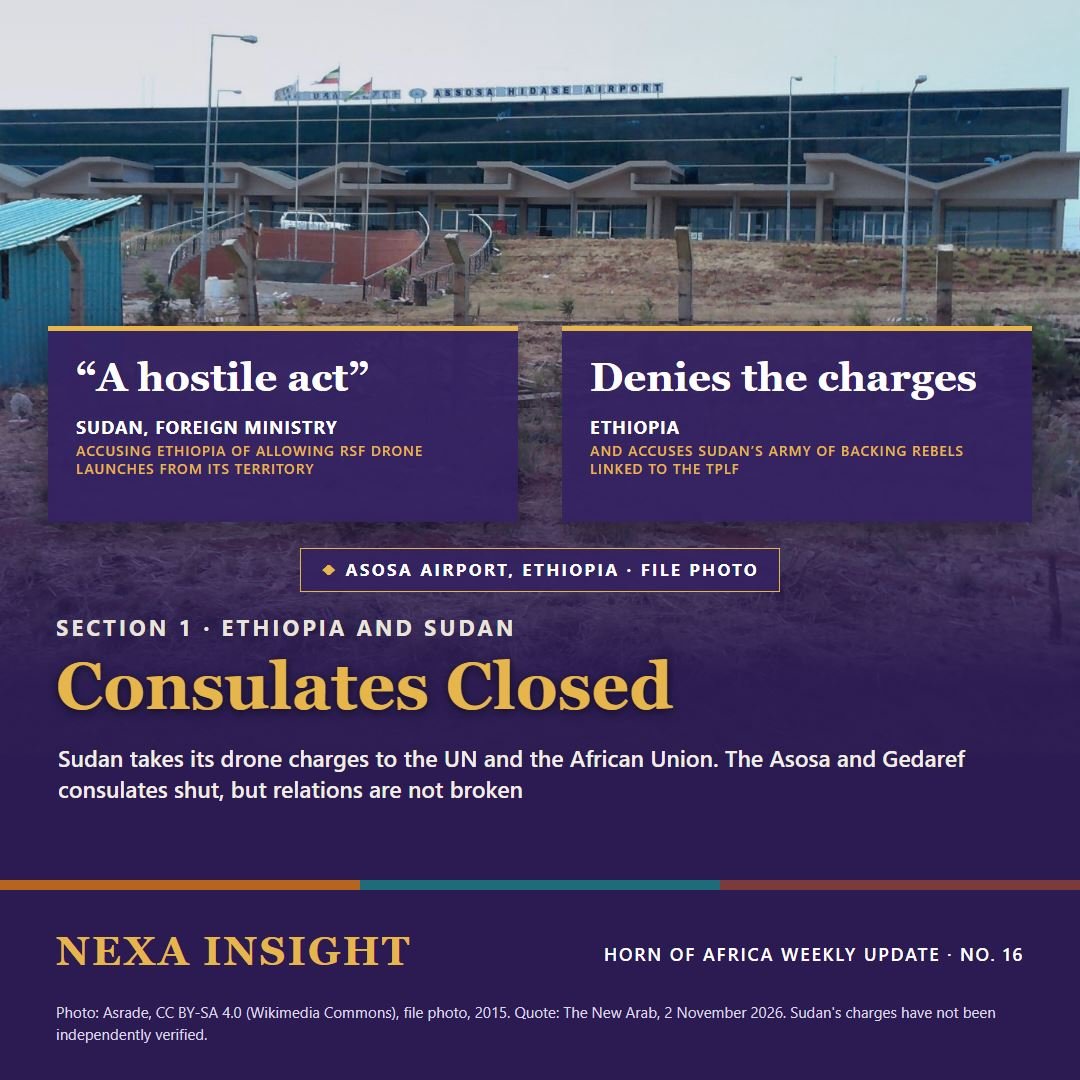
What happened: Sudan’s army-aligned government accused Ethiopia of allowing the RSF to launch drones from Ethiopian territory. Its foreign ministry described this as “a hostile act that places Ethiopia in violation of international law” (The New Arab, 2 November). A report by Sudan’s Transitional Sovereignty Council counts 70 attacks with 187 one-way attack drones between 15 February and 27 October. It says 484 civilians were killed or wounded, and it names Asosa Airport, the Kurmuk-Gizen border area and Bahir Dar airbase as launch sites (Al Jazeera and AFP, via Yahoo). These are Sudan’s own figures, and they differ from the 162 attacks its officials announced on 28 October (see Issue 15). They have not been independently verified.
Ethiopia denies the accusations and has accused the Sudanese army of backing rebels linked to the TPLF (The New Arab). A senior Ethiopian official told Reuters that the six staff of the Sudanese consulate in Asosa had been given 48 hours to leave, without giving a reason (SABC News, citing Reuters). Sudan answered by closing the Ethiopian consulate in Gedaref. Amjad Farid, an adviser to Sudan’s Transitional Sovereignty Council, then said: “The Sudanese government remains committed to its right to defend its territory. Nevertheless, it is making every possible effort to avoid an open war with Ethiopia” (Al Jazeera, 4 November).
The dispute sits inside a wider drone war. UN Secretary-General António Guterres, through a spokesman, condemned “the escalating drone attacks in Sudan by the parties to the conflict” (Al Jazeera and AFP, via Yahoo). Human Rights Watch said on 6 November that the UN had reported over 300 people killed in drone attacks in Sudan in the first three weeks of October.
Analysis: The two governments chose a measured step. A consulate is not an embassy, and both reports describe closures near the border, not a break in relations. That is the difference from Eritrea, which cut all ties with Ethiopia on 1 October. Mr. Farid’s words show the same caution: Khartoum is building a legal case while saying it wants to avoid war. Ethiopia’s position has a logic of its own. It sees rebels on its northern and western flanks and suspects its neighbours of helping them.
The strategic point is geography. Asosa is the capital of Benishangul-Gumuz, the region that hosts the Grand Ethiopian Renaissance Dam, and the US Congressional Research Service lists it among the areas where fighting continues. Each government now holds a complaint against the other, and each loses a local channel for managing border incidents just as those incidents increase. The Research Service warns that Ethiopia’s rebellions and its tensions with Eritrea, Egypt and Sudan “threaten to spur a broader regional conflict.”
Effects: For diplomacy, the question now goes to the UN and the African Union, and Nexa Insight found no public action by either body by 7 November. For security, the Ethiopia–Sudan border is less managed than it was a week ago. For Egypt, which also expelled an Ethiopian diplomat last month, the dispute strengthens its alignment with Sudan and Eritrea.
2. Ethiopia and Eritrea: China’s envoys and Asmara’s list
KEY EVENTS THIS WEEK
- 2 Nov: China says special envoys will visit the region in early and mid-November: Liu Xianfa to Ethiopia, Djibouti and Egypt, and Hu Changchun to Eritrea.
- 2–3 Nov: Eritrea’s Ministry of Information publishes and updates a list titled “Ethiopia’s Overtly Declared War Agenda Against Eritrea.”
- 5 Nov: President Isaias Afwerki meets Hu Changchun in Asmara.
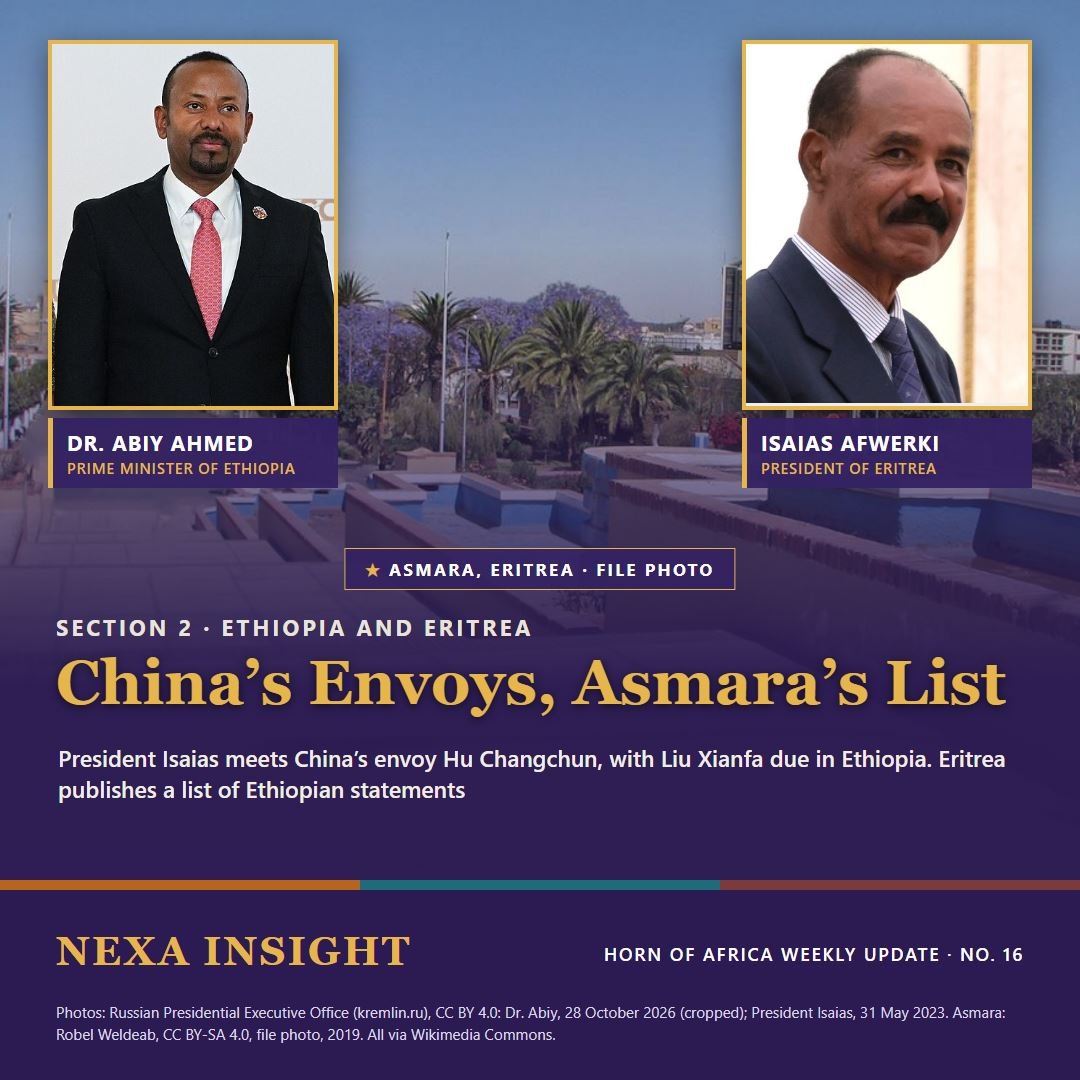
What happened: China’s foreign ministry spokesperson Mao Ning said the visits “are aimed at promoting talks for peace, easing tensions, and playing a constructive role for upholding regional peace and stability” (The New Arab, 2 November). In Asmara, according to Eritrea’s Ministry of Information, Mr. Hu “reiterated the People’s Republic of China’s position on the imperative of respecting Eritrea’s sovereignty and territorial integrity” (APO Group, 6 November). Nexa Insight found no report by 7 November that Mr. Liu had reached Addis Ababa.
Eritrea’s list gathers statements it attributes to Dr. Abiy Ahmed, senior commanders and other officials about sea access and the port of Assab. It presents them as “verbatim,” but gives no dates or sources for them. It attributes to Dr. Abiy the words: “Sovereign access to the sea by any means necessary – through negotiations if possible and by force if necessary” (Shabait). Nexa Insight could not confirm this wording from an independent record.
Ethiopia’s recorded public position is different. In March 2026, Dr. Abiy said: “We have no intention of invading or attacking others, but we won’t be ashamed to ask for access to a port” (AP, via Africanews). On 5 October, he told parliament: “Based on the principle of give and take, we will work diligently to ensure that Ethiopia has an outlet to the sea” (Al Jazeera). On 19 October, he warned that ignoring Ethiopia’s calls “will have very, very, very severe consequences,” and also said: “Good neighbourly relations and partnership are the only way forward” (AFP, via France 24). Ethiopia, for its part, accuses Eritrea of aggression: its foreign minister told the UN Security Council that Eritrean troops had crossed into Tigray, which Eritrea rejects (Al Jazeera, 11 October).
A correction to Issue 15: We reported Dr. Abiy’s announcement that Ethiopia had received 12 Su-35 jets. His statement did say “the first twelve.” Russia’s arms exporter, Rosoboronexport, told Reuters that the initial batch was two aircraft, and the published images show two (The Aviationist, 30 October). The number actually delivered is therefore disputed, and the other jets and the S-400 batteries have no public delivery date.
Analysis: Beijing has now joined Washington and Moscow in the search for a role in this dispute. Its method is careful: one envoy for each side, with a sentence on sovereignty that Asmara was glad to publish. Any reading of China’s intent should wait for the Ethiopian leg of the tour, which may carry a matching message about Ethiopia’s interests. Eritrea’s list is an act of diplomacy as much as a record. By placing Ethiopian statements in one document, Asmara prepares its case for foreign capitals that a war, if it comes, would not be of Eritrea’s making. Addis Ababa makes the opposite case, with its letters to the Security Council. Both are writing the legal story before any wider fighting begins.
Effects: For diplomacy, China adds a channel, but neither side has moved its position in public. Russia’s offer to host talks (see Issue 15) has had no public acceptance in the reports we opened. For security, the Research Service judges that “both Ethiopia and Eritrea appear to be preparing for war.”
3. Inside Ethiopia: Aksum, and ministers in military training
KEY EVENTS THIS WEEK
- 31 Oct: Fighting near Aksum. On 2 November, the TPLF claims 500 federal soldiers killed and 800 wounded. The figures are not verified.
- 31 Oct: Dr. Abiy Ahmed announces that ministers and senior officials are in military training at the Hurso centre.
- 6 Nov: Human Rights Watch reports on conduct by both sides in Tigray.
What happened: The TPLF said its forces had launched a counter-offensive near Aksum against federal troops and the allied Tigray Peace Force. Anadolu Agency reported that the government had not commented on the figures and that they could not be independently verified (Anadolu, 2 November). The Congressional Research Service says joint military and Tigray Peace Force operations forced the TPLF out of Mekelle in early October, that Dr. Abiy announced a caretaker government with elections promised within six months, and that the TPLF rejects that authority. Fighting continues in parts of Tigray, Amhara, Oromia and Benishangul-Gumuz (CRS, via Eurasia Review, 7 November).
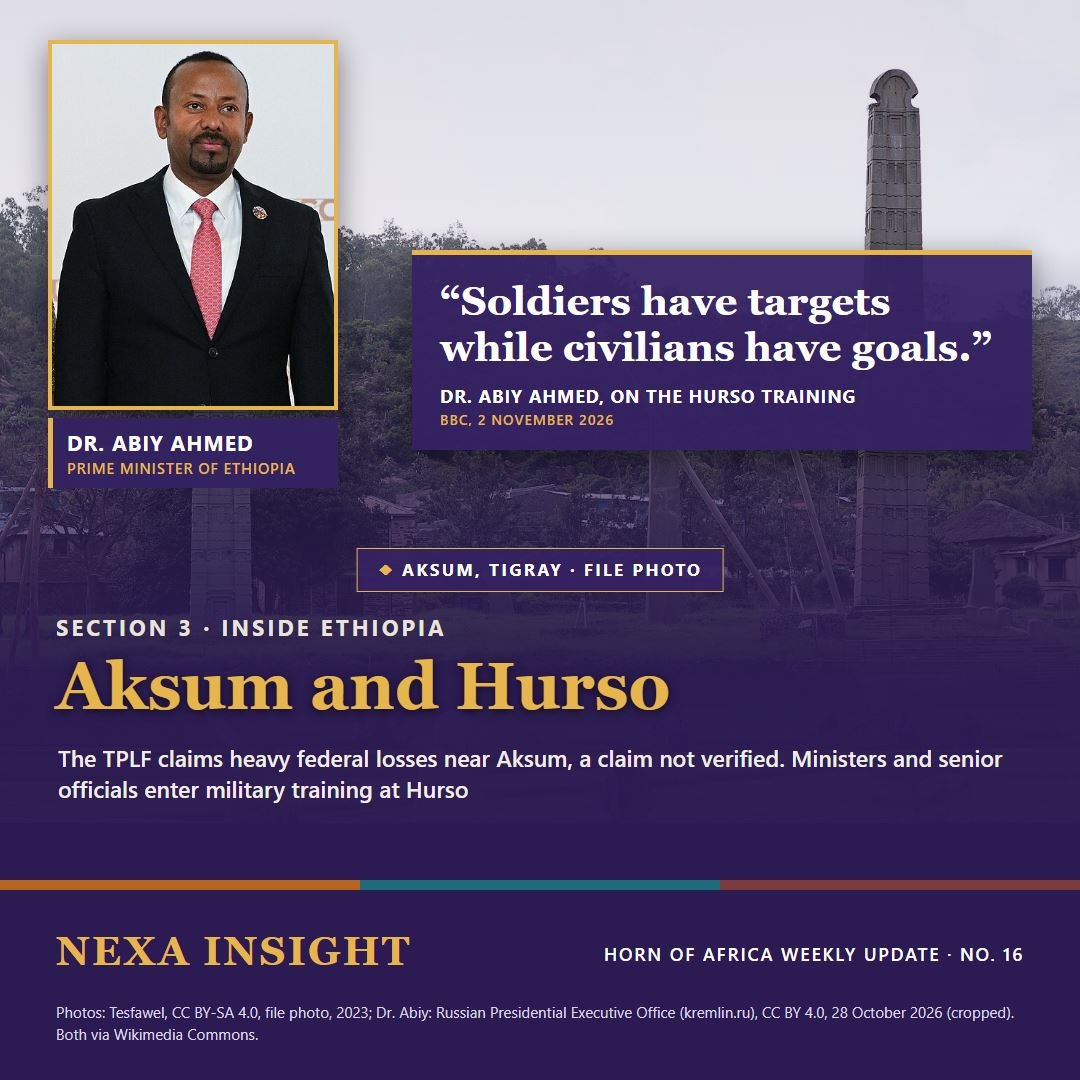
At Hurso, Dr. Abiy joined the training himself and shared photos on social media. He wrote that the leadership “must be physically strong, morally steadfast, knowledgeable, and disciplined in conduct” (Horn Diplomat, via allAfrica). He also said: “Soldiers have targets while civilians have goals. The objective of both is victory” (BBC, via MyJoyOnline). The BBC report calls the move unusual for Ethiopia, and says it is not clear when the training began or how long it will last.
Civilians continue to bear the cost. A drone strike on the Hayiq Jari 2 displacement camp in Amhara on 29 October killed at least 16 people, later reported as at least 18, and the reports we opened do not say who carried it out (Addis Standard, via allAfrica). Human Rights Watch said Tigrayan authorities and forces have been abducting and unlawfully recruiting civilians, including boys as young as 15, and that apparent government airstrikes, including drone strikes, have escalated in Tigray since August.
Analysis: Taking Mekelle changed who administers Tigray’s capital, but the claimed battle near Aksum suggests the contest has moved to the countryside, where it could last longer. The next test is the promised election within six months. The Hurso training is best read as a signal: the government is telling its own officials, and its neighbours, that it regards this as a period of national mobilisation. A separate Nexa article looks at what this and other steps say about Dr. Abiy’s direction.
Effects: For Tigray, there is no political process that includes the TPLF. For the federal government, several fronts now compete for the same forces. For civilians, drones remain the main danger, in Ethiopia as in Sudan.
Key points for regional decision-makers
- On Ethiopia and Sudan: Watch whether the Security Council or the African Union takes up Sudan’s complaint, and whether either side goes beyond consulates to embassies.
- On China: Compare the message of Mr. Liu’s visit to Addis Ababa with Mr. Hu’s message in Asmara.
- On Somalia: The National Salvation Forum accepted President Hassan Sheikh Mohamud’s offer of dialogue and named a three-member committee ahead of the 14–18 November talks in Mogadishu (FTL Somalia, 4 November). Puntland’s President Said Abdullahi Deni called the talks “a waste of time” and advised the president to resign (WardheerNews, 1 November).
- On Somaliland: On 3 November, President Abdirahman Mohamed Abdullahi Irro accused Somalia’s federal government of trying to station troops in eastern Sool and said his administration would resist. The federal government has not said officially whether forces will be stationed there (Dawan Africa, 3 November).
Bottom line
This week the region’s disputes became more formal. Sudan went to the Security Council, Ethiopia and Sudan closed consulates, and Eritrea published its case. These are the moves of governments preparing an argument as well as a defence, and both Sudan and Ethiopia still stopped short of breaking relations. In the next issue, we will follow any UN or African Union response, China’s visit to Addis Ababa, and the Mogadishu talks.
References
Al Jazeera (2026). Sudan, Ethiopia shut each other’s consulates in tit-for-tat move: Reports, 4 November. aljazeera.com
Al Jazeera and AFP, via Yahoo News (2026). Sudan files complaints against Ethiopia with UN over deadly drone spree, 2 November. yahoo.com
The New Arab (2026). Sudan files UN Security Council complaint over ‘Ethiopia drones’, 2 November. newarab.com
The New Arab (2026). Ethiopia and Sudan close each other’s consulates, 5 November. newarab.com
The National (2026). Sudan and Ethiopia in retaliatory expulsions of diplomats as tensions rise, 5 November. thenationalnews.com
SABC News, citing Reuters (2026). Ethiopia, Sudan close each other’s consulates, 5 November. sabcnews.com
Addis Standard, via allAfrica (2026). Sudan Lodges Formal Complaints Against Ethiopia With UNSC, AU Peace and Security Council, 3 November. allafrica.com
NewsCord (2026). Sudan says it shot down hostile drone from Ethiopia, 3 November. newscord.org
Human Rights Watch (2026). Remarks to the Subcommittee on Human Rights, 6 November. hrw.org
Blanchard, L. P., Congressional Research Service, via Eurasia Review (2026). The Unfolding Conflict in Ethiopia, 7 November. eurasiareview.com
The New Arab (2026). Chinese special envoys set to tour Middle East, Africa, 2 November. newarab.com
APO Group, Eritrea Ministry of Information (2026). President Isaias Afwerki Meets Chinese Special Envoy, 6 November. africa-newsroom.com
Shabait, Eritrea Ministry of Information (2026). Ethiopia’s Overtly Declared War Agenda Against Eritrea, updated 3 November. shabait.com
AP, via Africanews (2026). Abiy Ahmed insists Ethiopia will not go to war over sea access, 4 March. africanews.com
Al Jazeera (2026). Ethiopian PM Abiy demands Red Sea access as tensions with neighbours rise, 5 October. aljazeera.com
Al Jazeera (2026). Ethiopia, Eritrea ramp up rhetoric: Are they inching towards war?, 11 October. aljazeera.com
AFP, via France 24 (2026). Ethiopia PM warns Eritrea of ‘severe consequences’ if supports enemies, 19 October. france24.com
The Aviationist (2026). Ethiopia Receives First Russian Su-35 Fighters in Moscow, 30 October. theaviationist.com
Anadolu Agency (2026). Tigray rebels claim 500 Ethiopian soldiers killed, 800 wounded in renewed fighting, 2 November. aa.com.tr
Horn Diplomat, via allAfrica (2026). Abiy Joins Ministers in Military Drills, Calls for Disciplined Leadership, 1 November. allafrica.com
BBC, via MyJoyOnline (2026). Ethiopian PM puts ministers through military training, 2 November. myjoyonline.com
Addis Standard, via allAfrica (2026). Drone Strike Kills 16, Injures 22 at Hayiq Jari 2 IDP Camp, 29 October; Survivors Flee Hayiq Jari IDP Camp, 2 November. allafrica.com
FTL Somalia (2026). Opposition Forum Accepts Dialogue with Government, 4 November. ftlsomalia.com
WardheerNews (2026). Puntland President Warns Somalia is Approaching a Breaking Point, 1 November. wardheernews.com
Dawan Africa (2026). Somaliland President Accuses Somalia of Seeking to Deploy Troops to Eastern Sool, 3 November. dawan.africa
Abdinasir Hassan Timoweyne is a political analyst, Founder and Director of the Nexa Centre, and Senior Lecturer in International Relations at New Generation University. He is the author of several published articles on Horn of Africa and Middle East politics.