
Horn of Africa Weekly Update · Issue No. 14
Nexa Insight · Horn of Africa Weekly Update
Reference: NRTC/HAWU/2026-14 | Coverage: 21–27 October 2026, with 17–20 October background where it explains the week | Published: 27 October 2026
This week
Three files led the Horn this week. In Somaliland, Hargeisa and Mogadishu gave opposite accounts of their dispute over visas, and Hargeisa then set new rules for airline tickets sold for flights leaving its airports. In Tigray, the federally appointed caretaker government called on TPLF fighters to disarm, while the TPLF’s military commander called on them to fight on. Between Ethiopia and Eritrea, Dr. Abiy Ahmed called for good neighbourly relations and, in the same speech, warned Eritrea of “very, very, very severe consequences”. The Russia–Africa summit in Moscow on 28–29 October is the next date to watch.
1. Somaliland: Hargeisa sets the rules for its airports
KEY EVENTS THIS WEEK
- 19–21 Oct: The head of the Somali Civil Aviation Authority says the e-visa dispute with Somaliland “has been resolved”. Outlets give different dates for the remarks.
- 20–21 Oct: Somaliland’s Minister of Civil Aviation, Fu’aad Ahmed Nuuh, tells BBC Somali that there is no agreement.
- 21–22 Oct: Foreign Minister Abdirahman Dahir Adan Bakal tells the Cabinet that Somaliland’s international standing has grown since President Irro’s visit to the United States.
- 25 Oct: Somaliland’s Ministry of Civil Aviation and Airports Development stops accepting tickets issued through Somalia’s ticket-settlement system for flights leaving Hargeisa and Berbera.
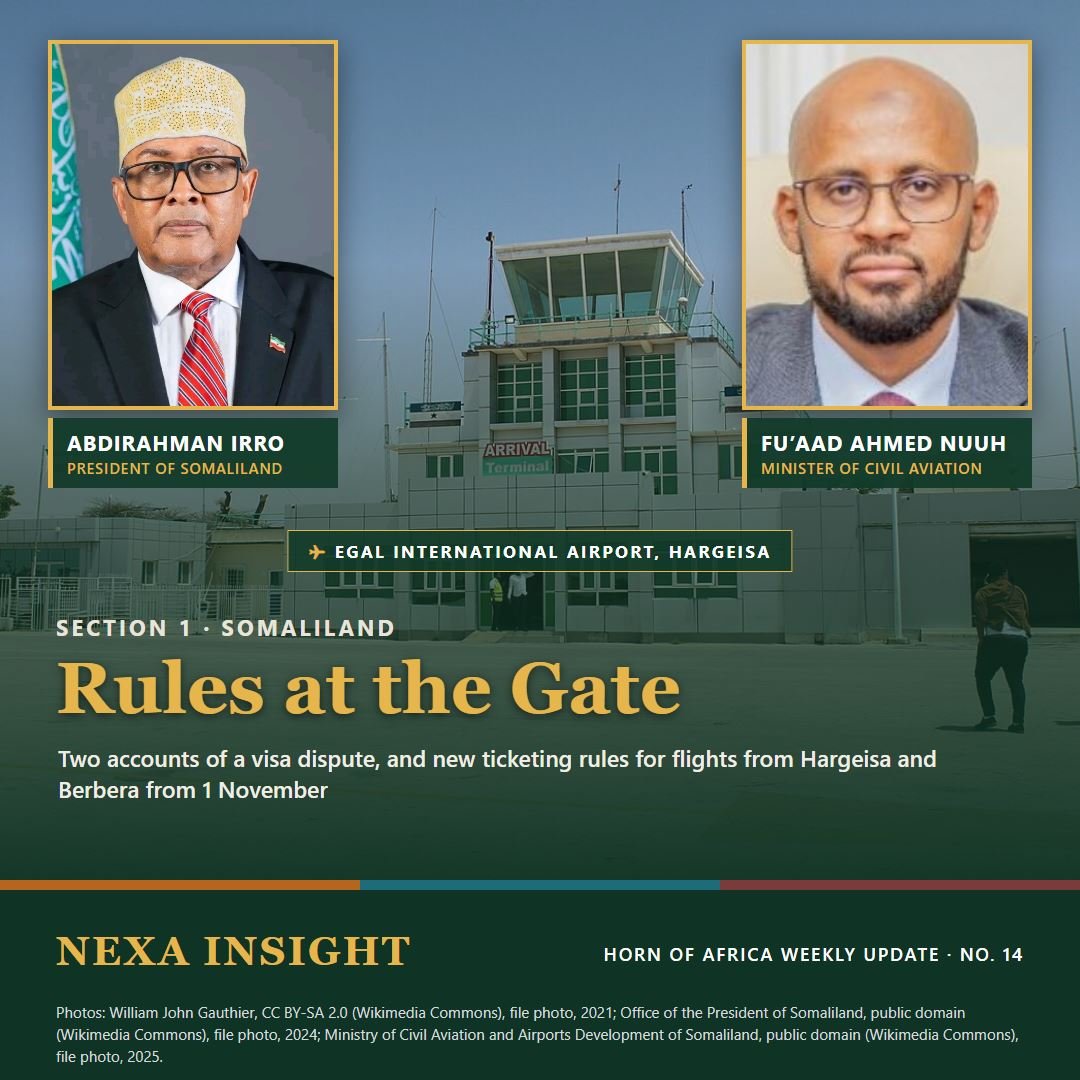
What happened: Mogadishu introduced an electronic visa in 2025. In November 2025, Somaliland rejected it. President Irro said Somaliland’s airspace falls under its own jurisdiction and required overflight and landing permits from its Ministry of Civil Aviation (Garowe Online). This week, Ahmed Moallim Hassan, Director General of the Somali Civil Aviation Authority, said that “the recent dispute concerning the eVisa has been resolved” and that “there is now a mutual understanding regarding the implementation of the system” (The Somali Digest). Somaliland’s Minister of Civil Aviation, Fu’aad Ahmed Nuuh, rejected this in an interview with BBC Somali: “There is nothing, because if it had been agreed, their visa would have worked in Somaliland, and it does not work.” He said visitors arriving with the federal e-visa are issued a Somaliland visa instead (Somali Dispatch; The Somali Digest). Neither side has published the text of any agreement.
At the 78th Cabinet meeting in Hargeisa, chaired by President Abdirahman Mohamed Abdillahi (Irro), Foreign Minister Bakal said Somaliland’s international standing had strengthened after the President’s visit to the United States, and that President Trump’s remarks had opened opportunities for new relationships (Horn Diplomat, via allAfrica).
On 25 October, the Ministry of Civil Aviation and Airports Development said it would no longer accept tickets issued through Somalia’s Billing and Settlement Plan (BSP) for departures from Hargeisa Egal International Airport and Berbera International Airport. The BSP is the airline industry’s system, run by the International Air Transport Association (IATA), through which travel agents sell tickets and pay airlines. The rule took effect immediately and covers tickets already sold, including return tickets. Passengers must buy through airline websites and offices, airport counters, or travel agents licensed by Somaliland. Airlines have until 31 October to notify agents that are not compliant. From 1 November, they may work only with agents that meet Somaliland’s licensing rules (Horn Diplomat; Dawan; Somali Dispatch). The ministry gave no further reason. Nexa Insight found no response from Mogadishu or from airlines by 27 October.
Analysis: The two governments describe the same situation in opposite ways. No agreement has been published, and Somaliland says visitors to Hargeisa continue to receive a Somaliland visa. The underlying question is who regulates air travel through Hargeisa and Berbera. Somaliland’s answer is that its own authorities do, and this week it extended that authority from visas to ticket sales. Its position rests on day-to-day control: it runs the airports, issues the visas and licenses the agents.
The Foreign Minister’s Cabinet report points in the same direction. After President Irro’s visit to Washington and President Trump’s remarks, Hargeisa is working to turn that attention into regular diplomatic relationships. Rules that airlines and foreign governments deal with every day are part of how a government’s authority becomes recognised in practice.
Effects: For airlines and travel agents, Somaliland’s licensing rules apply to tickets for flights out of Hargeisa and Berbera from 1 November. For relations between Hargeisa and Mogadishu, the gap between the two accounts means the air-travel dispute remains open. Mogadishu’s response to the ticketing rule is the next thing to watch.
2. Abiy’s war with the TPLF: a call to disarm, and a call to fight on
KEY EVENTS THIS WEEK
- 17 Oct: US Secretary of State Marco Rubio blames attacks by groups he calls “separatists” for the escalation inside Ethiopia. He does not name the TPLF.
- 18 Oct: The seven-group opposition coalition known as the Alliance for Survival rejects the separatist label.
- 19 Oct: In a speech in Tigrinya, Dr. Abiy says the TPLF’s “existence is coming to an end”.
- 22 Oct: Lt Gen Fisseha Kidanu, named on television as commander of the Tigray army, calls on militias and volunteers to “engage the enemy”.
- 23 Oct: Redae Halefom Woldeselassie, a senior caretaker official, urges TPLF fighters to disarm and “return to your homes”.
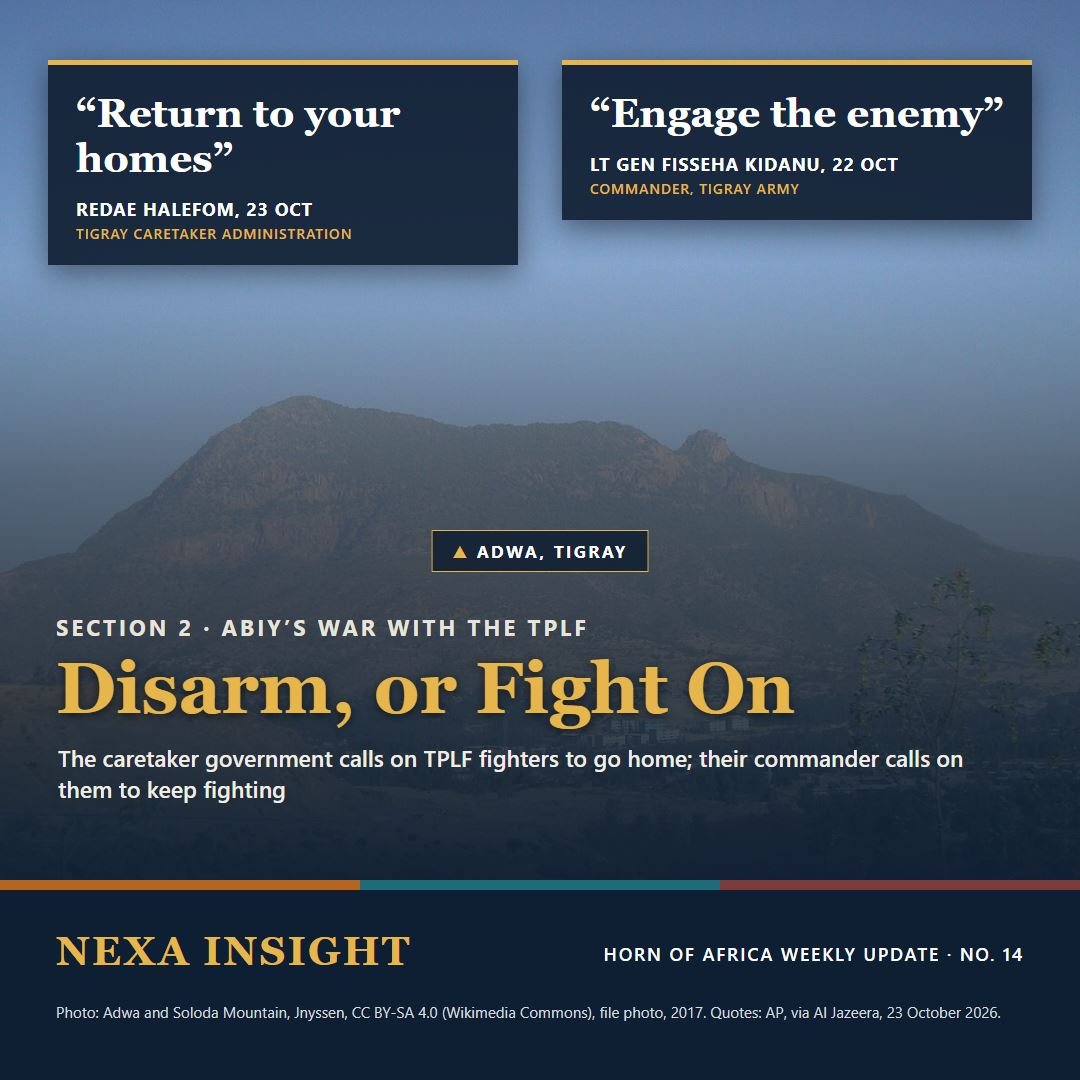
What happened: The federal government installed a six-month caretaker administration in Tigray on 16 October, after TPLF forces withdrew from Mekelle earlier in the month (AFP, via France 24). On 22 October, Lieutenant General Fisseha Kidanu, identified in a broadcast as commander of the Tigray army, vowed to reverse recent setbacks: “Local militias across the region – alongside all volunteers joining the resistance – are expected to engage the enemy.” The next day, Redae Halefom Woldeselassie, a senior official in the caretaker administration, said: “This is not the time for settling scores – I call upon you to return to your homes and continue your civilian lives.” He urged fighters to join the disarmament programme (AP, via Al Jazeera). In his 19 October speech, Dr. Abiy said: “The TPLF did not exist 50 years ago, and now its existence is coming to an end” (AFP, via France 24).
Speaking to reporters at Joint Base Andrews on 17 October, Secretary Rubio blamed attacks by groups he called “separatists” inside Ethiopia for the initial escalation. He did not name the TPLF (The Reporter Ethiopia). The Alliance for Survival, which includes the TPLF, rejected the label on 18 October (Addis Standard, as cited by the Council on Foreign Relations).
Fighting has continued in parts of central Tigray. The Europe External Programme with Africa (EEPA), a Brussels-based research group, reported clashes and drone strikes there between 19 and 21 October. It also reported a TPLF casualty claim, which has not been independently verified. Nexa Insight found no independent confirmation of major changes in territorial control during the coverage week.
Analysis: The two statements of 22 and 23 October show the contest as each side now sees it. The federal side is moving from military operations to administration: disarmament, civilian life, and an election within six months. The TPLF leadership is calling for continued resistance. Each side’s aim is clear. The caretaker government needs fighters to leave the field so that it can show results. The TPLF needs to stay in the field so that it can contest the new administration’s authority.
The US position matters for both. Rubio’s use of the word “separatists” sits alongside his call for de-escalation in the region. In his 14 October call with Dr. Abiy, he said that “all countries in the Horn of Africa must respect the sovereignty and territorial integrity of their neighbors” (AP, via ABC News). The opposition has rejected the label. How Washington describes the conflict will shape how much room each side has abroad.
Effects: For Tigray, the response of fighters to the disarmament call will be an early test of the caretaker administration. For security, both sides’ statements point to more fighting in the countryside. For diplomacy, the US description of the armed groups will be watched by both sides.
3. Ethiopia and Eritrea: good neighbourliness and a warning in one speech

KEY EVENTS THIS WEEK
- 17 Oct: Rubio says, “You see troops surging on both sides of the border,” and defends easing certain sanctions as a way to open diplomatic channels with Eritrea.
- 19 Oct: Dr. Abiy tells Eritrea that “good neighbourly relations and partnership are the only way forward”. He also warns that ignoring Ethiopia’s calls “will have very, very, very severe consequences”.
- 28–29 Oct (ahead): Russia–Africa summit in Moscow. Russia has offered to host contacts between Ethiopia and Eritrea there.
What happened: In a speech in Tigrinya on 19 October, Dr. Abiy said: “Serving as a base for Ethiopia’s enemies instead of being a partner in development will not bring benefits.” He added: “I believe that ignoring our calls will have very, very, very severe consequences,” and “Good neighbourly relations and partnership are the only way forward” (AFP, via France 24). Eritrea denies supporting armed groups inside Ethiopia and denies sending troops into Ethiopian territory (Al Jazeera). Nexa Insight found no Eritrean response to the speech by 27 October.
Two days earlier, Secretary Rubio said, “You see troops surging on both sides of the border.” He urged a measured response and defended easing certain sanctions, which he described as targeted, as a way to open diplomatic channels with Eritrea (The Reporter Ethiopia). In Zalambessa, the border town that federal forces reached by 13 October (Reuters), a resident told Al Jazeera: “People are worried because we know what war means for this area.”
Russia’s Deputy Foreign Minister Alexander Alimov has said Moscow is ready to provide a platform for contacts between the two sides, including on the sidelines of the 28–29 October summit, if both are interested (Addis Standard; Horn Review). Neither government has said publicly that it wants talks, and Nexa Insight could not confirm which leaders will attend.
Analysis: Dr. Abiy’s speech joined an offer and a warning: good neighbourly relations if Eritrea stops what Addis Ababa says is support for its enemies, and severe consequences if it does not. Eritrea rejects the premise of the charge. Neither side has changed its position in public.
Outside powers are moving in the meantime. Washington is trying to reopen channels with Asmara while warning of a troop build-up on both sides. Moscow is offering a venue. A summit gives both leaders a setting where contact need not be presented as a concession. Whether any contact happens in Moscow will say more about the next stage than this week’s statements.
Effects: For security, troop concentrations on both sides of the border, as described by the US Secretary of State, keep the risk of a clash alive. For diplomacy, the US effort to open channels with Asmara and Russia’s offer open possible channels for both governments. The Moscow summit is the nearest test.
Key points for regional decision-makers
- On Somaliland: Hargeisa’s ticketing rules apply from 1 November. Airlines and partners should work from the rules in force at Hargeisa and Berbera. No visa agreement with Mogadishu has been published.
- On Abiy and the TPLF: Watch the fighters’ response to the disarmament call and the caretaker administration’s delivery of services. These will show more than claims from either side.
- On Ethiopia and Eritrea: Read the 19 October speech as an offer and a warning together. Watch Moscow on 28–29 October for any contact between the two governments.
Bottom line
This week’s statements set out positions more than they changed facts. Hargeisa and Mogadishu disagree on whether a visa dispute is settled, and Hargeisa has extended its rules to airline tickets. In Tigray, the caretaker government and the TPLF made opposite calls to the same fighters. Between Ethiopia and Eritrea, Addis Ababa paired an offer with a warning, while Washington and Moscow opened possible channels. In the next issue, we will track Mogadishu’s and the airlines’ response to Somaliland’s ticketing rules, the progress of disarmament in Tigray, and whether Dr. Abiy and President Isaias have any contact in Moscow.
References
The Somali Digest (2026). Somali Civil Aviation Authority Declares the Visa Row Over and Hargeisa Still Cancels Its Visas, 21 October. thesomalidigest.com
Somali Dispatch (2026). Somaliland Aviation Minister Denies New Airspace Agreement with Somalia, 20 October. somalidispatch.com
Garowe Online (2025). Somaliland Rejects Somalia Govt’s E-Visa, Deepening Rift Over Airspace, 9 November. garoweonline.com
Horn Diplomat, via allAfrica (2026). Somaliland Government Highlights Trump’s Remarks, Diplomatic Progress, 22 October. allafrica.com
Horn Diplomat (2026). Somaliland Bars Tickets Issued Through Somalia’s BSP, 25 October. horndiplomat.com
Dawan (2026). Somaliland Rejects Somalia-Issued BSP Tickets for Its Airport Departures, 25 October. dawan.africa
Somali Dispatch (2026). Somaliland Bans Airline Tickets Issued Through Somalia’s BSP System, October. somalidispatch.com
Agence France-Presse, via France 24 (2026). Ethiopia PM warns Eritrea of ‘severe consequences’ if supports enemies, 19 October. france24.com
Associated Press, via Al Jazeera (2026). Tigray rebels urged to disarm as commander vows to fight Ethiopia’s gov’t, 23 October. aljazeera.com
The Reporter Ethiopia (2026). Rubio Urges Restraint As Ethiopia-Eritrea Tensions Risk Wider Regional War, 18 October. thereporterethiopia.com
Associated Press, via ABC News (2026). Rubio urges restraint over Ethiopia-Eritrea tensions as rights group reports civilians killed, 15 October. abcnews.com
Horn Review (2026). Commentary on Russia’s offer to facilitate Ethiopia–Eritrea dialogue, 17 October. hornreview.org
Al Jazeera (2026). Ethiopian forces expand control in Tigray as militia claims Eritrean losses, 15 October. aljazeera.com
Reuters (2026). Ethiopian troops enter town on border with Eritrea, stoking war fears, 13 October. reuters.com
Council on Foreign Relations (2026). Global Conflict Tracker: Conflict in Ethiopia, update of 18 October, citing Addis Standard. cfr.org
EEPA (2026). Situation Report, Horn of Africa, No. 772, 22 October. eepa.be
Al Jazeera (2026). Tigray resumes daily life amid fears of wider war, 22 October. aljazeera.com
Addis Standard (2026). Russia offers to host Ethiopia–Eritrea talks amid rising tensions, 17 October. addisstandard.com
Abdinasir Hassan Timoweyne is a political analyst, Founder and Director of the Nexa Centre, and Senior Lecturer in International Relations at New Generation University. He is the author of several published articles on Horn of Africa and Middle East politics.