
Horn of Africa Weekly Update · Issue No. 13
Somaliland Builds on Its Opening, Abiy Takes Charge in Tigray, and a War for the Baidoa Road
Nexa Insight · Regional Analysis · Horn of Africa Weekly Update
Reference: NRTC/HAWU/2026-13 | Coverage: 16–20 October 2026, with 13–15 October background where it explains the week | Published: 21 October 2026
This week
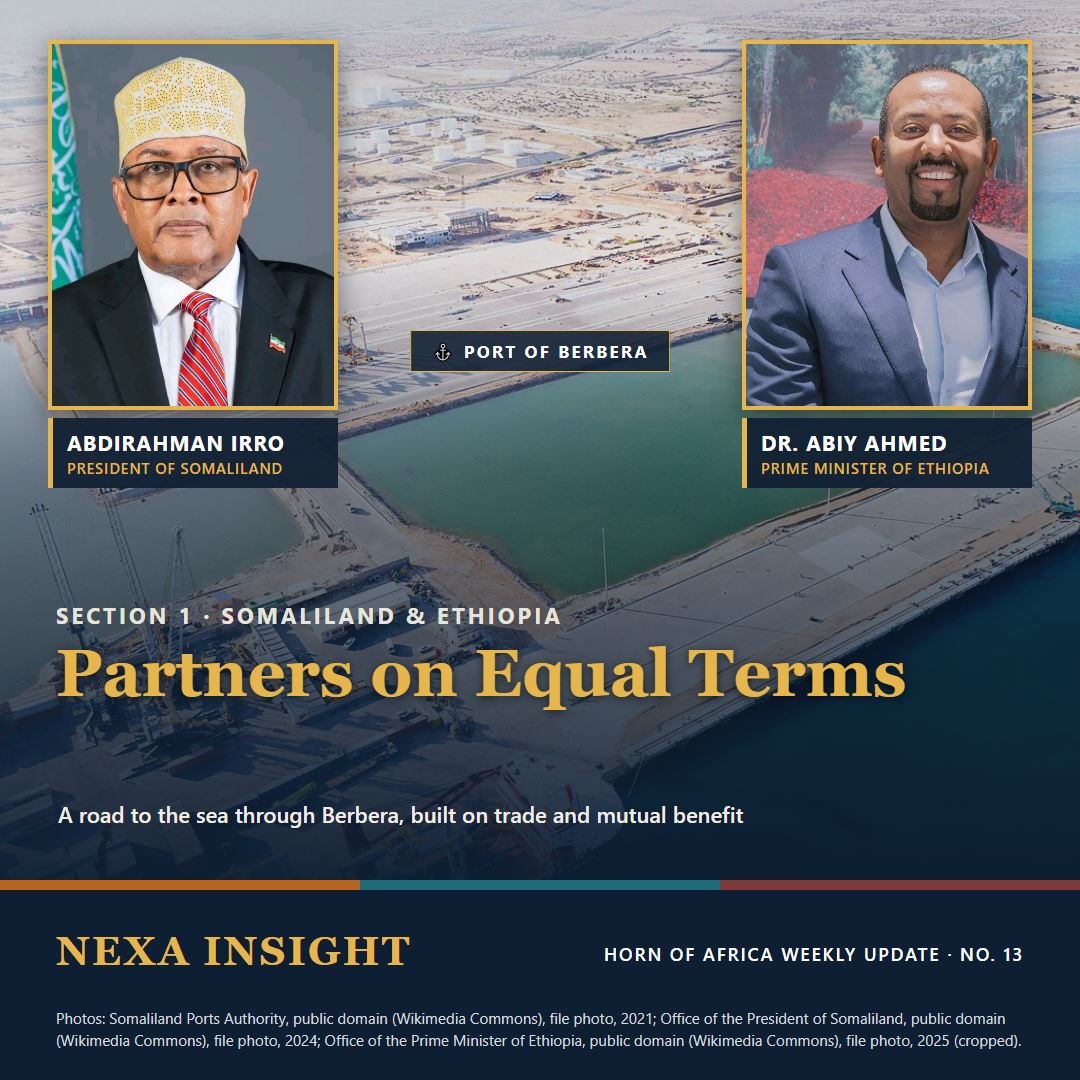
Three stories shaped the Horn this week. First, Somaliland’s President Abdirahman Mohamed Abdullahi (Irro) came home from Washington and Abu Dhabi and began turning President Trump’s words into working diplomacy, with Ethiopia as his chosen partner. Second, Prime Minister Dr. Abiy Ahmed moved from winning battles in Tigray to governing it: he named a six-month caretaker administration in Mekelle, while Russia offered to host talks between Ethiopia and Eritrea. Third, in Somalia, forces loyal to a removed regional president took towns around Baidoa, and Mogadishu prepared to strike back. In each case the question is the same: who holds the leverage, and who pays for using it.
1. Somaliland: President Irro comes home and turns Washington’s words into working diplomacy
KEY EVENTS THIS WEEK
- 14 Oct: Thousands rally at Hargeisa’s aircraft monument to thank President Trump and call for US recognition.
- 15 Oct: President Irro returns from the United States and the UAE and thanks Trump “for distinguishing the Republic of Somaliland from failed Somalia.”
- 15 Oct: Irro says Somaliland strongly opposes “any act that could endanger Ethiopia’s stability and security.”
- 17 Oct: Irro meets Somaliland’s newly appointed ambassadors and tells them to widen the country’s international ties.
What happened: Speaking at the presidential palace in Hargeisa, Irro said he came home “with confidence and very high hopes” that the results of his trip would “contribute to Somaliland’s future” (Horn Diplomat, via allAfrica). The day before, crowds had filled central Hargeisa around the city’s aircraft monument, waving US and Somaliland flags. On Ethiopia he was direct: “We strongly oppose interference and any act that could endanger Ethiopia’s stability and security” (Horn Diplomat; Hiiraan Online). On 17 October he met newly appointed ambassadors, an envoy and deputy ambassadors, with Foreign Minister Abdirahman Dahir Adan present, and told them to strengthen Somaliland’s diplomatic relations (Horn Diplomat).
Analysis: Words at a rally open a door; diplomacy has to walk through it. This week Hargeisa showed it understands that. Irro moved on three tracks at once. He fixed the message: Somaliland as the stable, working state next to “failed Somalia.” That contrast is Somaliland’s strongest asset in a Washington that judges partners by what they can deliver. He named his regional partner openly: Ethiopia. And he put a new team of diplomats to work the same week.
The choice of Ethiopia is a cold calculation, and a sound one. On 4 October Egypt, Eritrea, Sudan and Somalia met at El Alamein and declared that they reject any recognition of Somaliland; on 18 October Egypt’s and Somalia’s foreign ministers met again to follow up (EgyptToday). When a small state faces a coalition, it lines up with the strongest neighbour that shares its interests. Ethiopia, with more than 120 million people and no coast, needs the sea. Somaliland has the coast, the port of Berbera and the stability to make an agreement last. Each has what the other needs. By standing with Addis Ababa while it is under pressure, Hargeisa builds credit it can call on later. And the fact that four governments now organise against Somaliland’s recognition is itself a measure of how much Hargeisa’s weight has grown.
The memorandum question: Irro’s line on Ethiopia also marks a quiet change from the past. The memorandum of understanding signed in January 2024 by the previous government reportedly offered Ethiopia about 20 km of coastline for 50 years, including room for a naval presence, linked to Ethiopian recognition of Somaliland. Its text was never published, and it drew a sharp reaction from Mogadishu and its partners (The Africa Report; ISPI). After his election, President Irro said he would review the deal in detail (Garowe Online). His government has kept the goal but changed the language. On 3 October the Foreign Ministry said agreements giving Ethiopia sea access must rest on shared interests and mutual benefit (Kaab TV, citing Dawan). On 12 October Foreign Minister Abdirahman Dahir Adan Bakal told Sky News Arabia that Ethiopia has “the right to access the sea” and that Somaliland is “ready to discuss Ethiopia’s needs and arrangements,” and he pointed to Berbera, which he said runs at only 30–40 percent of capacity (Horn Diplomat, via allAfrica).
The difference matters. Leasing a stretch of coast with a military role is a question of territory; open access through a commercial port is a question of trade. The second is close to the model international law already sets out for landlocked states, under which access to the sea is arranged by agreement with a coastal neighbour (Part X of the UN Convention on the Law of the Sea). Seen from Hargeisa, that model has three advantages. It is easier to defend abroad, because it asks partners to accept a port agreement, not a transfer of territory. It is easier to build broad national support around, because it rests on trade and partnership. And it gives Somalia and Egypt’s bloc less to campaign against. It also lets Somaliland deal with Ethiopia as one sovereign state with another, on equal terms. In a region at war, Somaliland’s stability is its strongest asset, and this approach protects it.
Effects: For Somaliland, the results of the US trip now rest with a diplomatic service that has momentum and a clear message. For Ethiopia, Hargeisa’s public support comes at a useful moment, as it faces Eritrea and Egypt’s bloc, and it keeps a peaceful route to the sea open. For Somalia, the contrast between a calm Hargeisa and the fighting around Baidoa (Section 3) strengthens Somaliland’s case in every capital it visits.
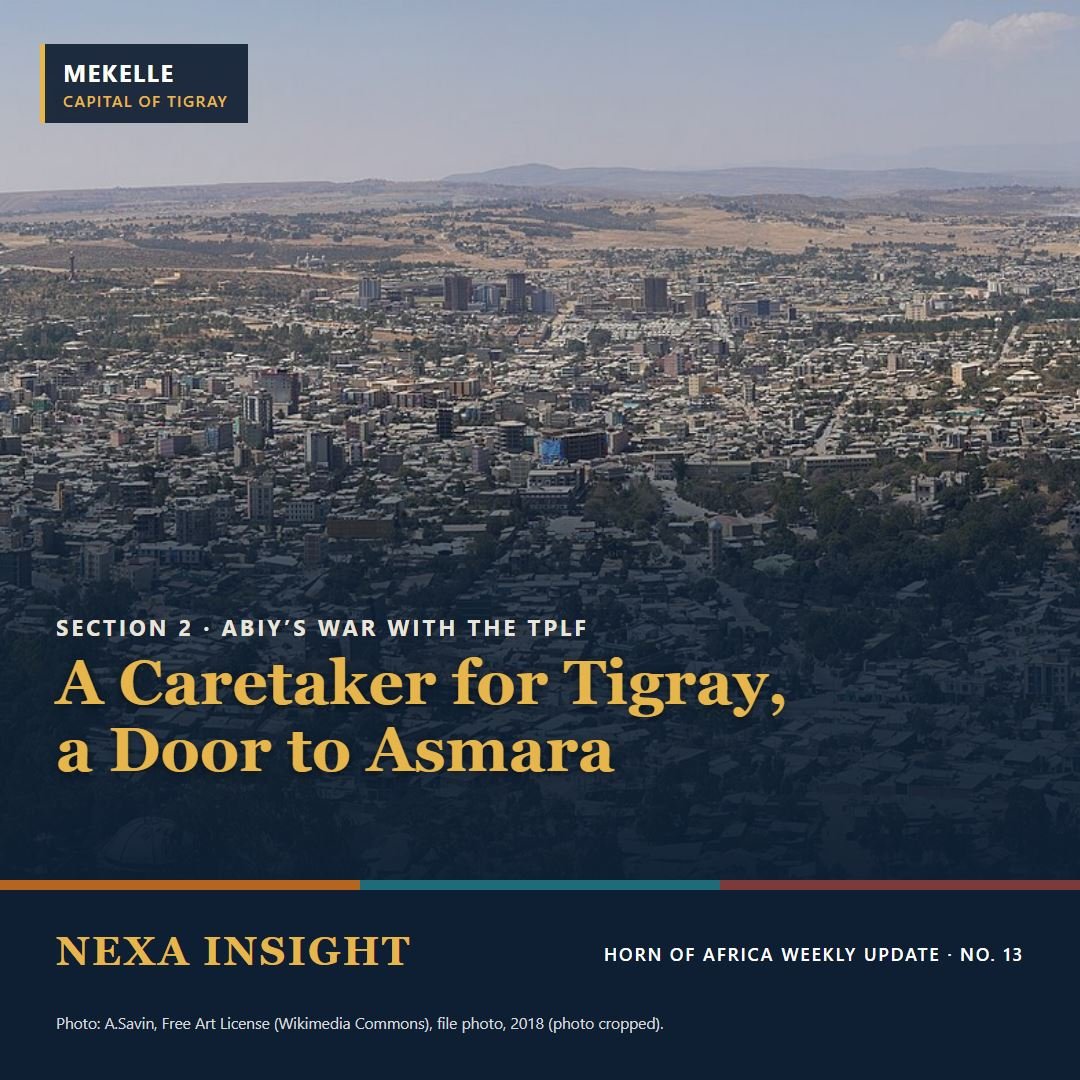
2. Abiy’s war with the TPLF: a caretaker government for Tigray, and a door to Asmara through Moscow
KEY EVENTS THIS WEEK
- 16 Oct: The Prime Minister’s Office names Assefa Abraha chief executive of a six-month caretaker administration for Tigray.
- 16 Oct: Registration of former Tigrayan fighters for disarmament resumes in Mekelle.
- 16–17 Oct: The TPLF rejects the administration as illegitimate and tells local institutions not to cooperate.
- 16–17 Oct: Russia’s deputy foreign minister says Moscow is ready to host Ethiopia–Eritrea contacts if both sides want them.
- 20 Oct: Tigray Peace Force commander Gebregziabher Beyene tells Mekelle residents that TPLF leaders have crossed into Eritrea with weapons and medicines. Eritrea and the TPLF both deny it (AFP).
What happened: Assefa Abraha is an engineer who led Ethiopia’s public enterprises authority from 1994 to 2001. He was jailed after the TPLF’s 2001 split and later served as a TPLF negotiator at the 2022 Pretoria talks (Addis Fortune; AP). His team includes Brigadier General Gebre-Egziabher Beyene for peace and security, who leads the government-allied Tigray Peace Force (AP); Tewodros Aregai for the economy and reconstruction; Redai Halefom for political affairs; and Shishay Amare as mayor of Mekelle. The mandate is to restore services, bring the displaced home, disarm and reintegrate fighters, and prepare an election within six months. The administration must also act under federal direction and avoid long-term strategic decisions (Addis Fortune). The AP reported former fighters lining up in Mekelle to register for disarmament, a programme that had been suspended as tensions rose. The TPLF called the new body illegitimate (EEPA; The Rio Times).
On Eritrea, Moscow made an offer. Deputy Foreign Minister Alexander Alimov told Izvestia that Russia would provide a platform for contacts, but only if both sides are interested. Reports link the offer to the Russia–Africa summit in Moscow on 28–29 October; Dr. Abiy has reportedly accepted President Putin’s invitation, and Eritrea’s President Isaias Afwerki is expected to attend (Addis Standard; Sputnik Africa). Neither government has said it wants talks. On 20 October, the Tigray Peace Force commander, now the caretaker security chief, said TPLF leaders had fled to Eritrea with arms. Eritrea’s Information Minister Yemane Gebremeskel called this “lies”, and the TPLF said its leaders are still in Tigray. AFP could not verify the claim (AFP, via The Peninsula).
Analysis — ruling Tigray: Dr. Abiy’s government has chosen a path that states emerging from internal conflict often take: governing the affected region through respected local figures rather than through outsiders. The choice of Assefa is central. He is a Tigrayan with long experience inside the TPLF, so the old leadership cannot call him an outsider, and his break with that leadership in 2001 gives him independence from it. The security portfolio goes to the commander of the Tigrayans who fought alongside federal forces. Overall direction stays with the federal government, which keeps the process inside one national framework, and the six-month timetable signals that the arrangement is meant to lead to an elected regional government.
The main test is consent. The TPLF has told local institutions not to cooperate and may try to keep its supporters away from any vote. Six months is short for returning the displaced, disarming fighters and holding a credible vote. If aid, salaries and services flow, many Tigrayans are likely to give the new order a chance. If they do not, the TPLF’s call to resist will find listeners.
Analysis — the Moscow door: Russia’s offer is about Russia as much as the Horn. Moscow wants a role on the Red Sea and has working ties with both Addis Ababa and Asmara. A mediator counts only if it has leverage over both sides. Russia has some, through arms and its veto at the Security Council; Washington and the Gulf have more money at stake. Still, a meeting in Moscow would let both leaders step back without looking weak. With the TPLF beaten, Eritrea has lost its proxy. Ethiopia, now focused on recovery and reconstruction in Tigray, has strong reasons to avoid a wider conflict. Both have motives to talk; neither has yet said yes. The 20 October claim that TPLF leaders are in Asmara, which Eritrea denies, shows how much distrust remains, even as the Moscow door stays open.
Effects: For Tigray, aid, salaries and disarmament in the coming weeks will decide whether the caretaker government is accepted. For security, expect the TPLF to test the new administration in the countryside. For diplomacy, the Moscow summit on 28–29 October is the next date to watch for any Ethiopia–Eritrea contact.
3. Somalia’s South West: a federal quarrel becomes a war for the Baidoa road
KEY EVENTS THIS WEEK
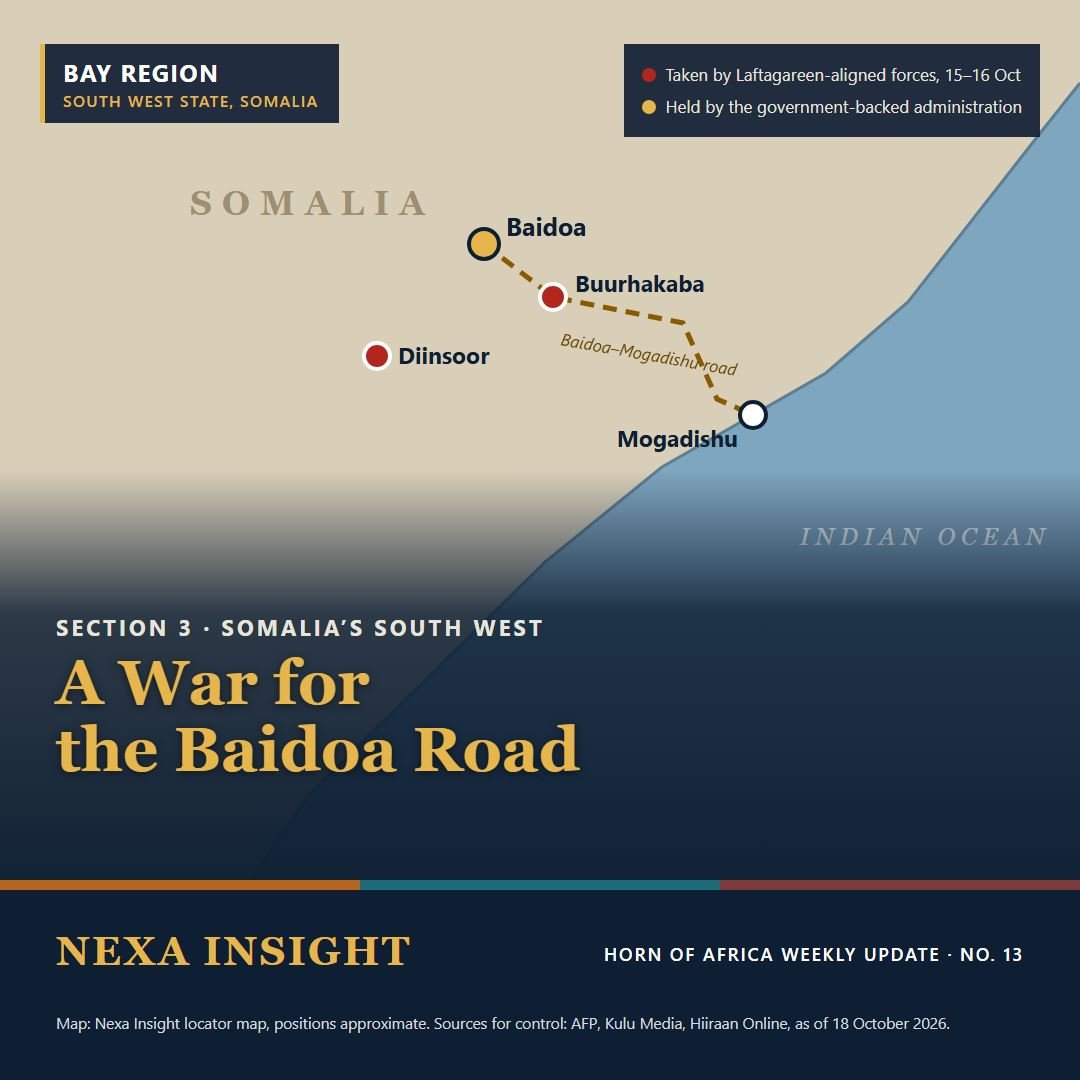
- 13 Oct: Somalia’s counter-terrorism financing committee puts Laftagareen and nine others on its sanctions list, citing suspected support for al-Shabaab.
- 15 Oct: Laftagareen-aligned forces take Buurhakaba, on the main road between Baidoa and Mogadishu.
- 16 Oct: They take Berdale and Diinsoor; Ethiopian troops at an African Union base in Berdale stay inside their compound.
- 17 Oct: Four district centres are under their control; Security Minister Isaaq Mohamed Isaaq says a counter-offensive is being prepared.
- 18 Oct: The government-backed South West administration announces an offensive to retake the towns, starting with Buurhakaba.
What happened: Federal forces entered Baidoa on 30 March 2026 and removed Laftagareen from the regional capital; his supporters reject the administration that replaced him (Kulu Media). This month his forces came back. Most towns changed hands without major fighting, as government-aligned forces pulled out (Hiiraan Online, as cited by Kulu Media). AFP reported that four district centres are now under their control and that Ethiopian troops in Berdale did not intervene (as cited by Kulu Media). Baidoa itself remains with the government-backed administration. Laftagareen’s office says it is restoring “security, stability and regional political authority” (Kulu Media). A former minister accused his forces of working with al-Shabaab; Horseed Media could not verify the claim, and the Somali Journalists Syndicate found that photos said to show an al-Shabaab leader in Diinsoor were AI-altered copies of 2016 Al Jazeera images (Horn Observer). The sanctions decision did not publish its evidence (Kaab TV). No side has given casualty figures.
Analysis: This is a fight over who controls Somalia’s federal member states before the 2027 elections. President Hassan Sheikh Mohamud’s government wants loyal administrations in the regions that will run the vote. Regional leaders who resist are pushed out, as Laftagareen was in March. His return shows the limit of that method: a leader removed by force keeps his clan base, his fighters and his outside friends. Calling him an al-Shabaab ally may help Mogadishu abroad, but the evidence has not been made public, and the fake photos show that the information war is running ahead of the facts.
The outside dimension matters most for the region. Bay sits next to Bakool and Gedo, which border Ethiopia, and Ethiopian troops have served in the area for years, both under the African Union and on their own. This week Ethiopia’s soldiers in Berdale stayed in their base; Addis Ababa has not commented, and that restraint kept its forces out of an internal Somali dispute. Mogadishu, meanwhile, has moved closer to Cairo, which is preparing new troop deployments to Somalia (The New Arab) and met Somalia’s foreign minister again on 18 October. When a federal quarrel sits on top of a rivalry between two regional powers, each local side looks for an outside backer, and each backer looks for local clients. That is how a local fight becomes a regional one. And the surest winner of any war between government forces and Laftagareen’s men is al-Shabaab, which gains whenever its enemies fight each other.
Effects: For security, a battle for Buurhakaba would threaten the main road between Baidoa and Mogadishu, a supply line for the city and for aid. For politics, voter registration is due to start on 1 November; fighting in Bay makes a credible vote there harder. For Ethiopia–Somalia relations, Ethiopia’s restraint so far leaves little ground for claims that it took sides.
Key points for regional decision-makers
- On Somaliland: Hargeisa’s open support for Ethiopia is a sound bet: it pairs Somaliland’s coast with the region’s largest landlocked state. Use the momentum from Washington to turn words into agreements on Berbera, maritime security and trade.
- On Abiy and the TPLF: Judge the caretaker government by delivery — aid, salaries, services, disarmament — not by announcements. The Moscow summit on 28–29 October is the nearest chance for an Ethiopia–Eritrea contact; watch who attends and who meets whom.
- On Somalia’s South West: Read the Bay fighting as part of the 2027 election contest and of the Egypt–Ethiopia rivalry. A war on the Baidoa road helps al-Shabaab more than either side.
Bottom line
This was a week of turning gains into position. Somaliland is turning a US president’s words into a diplomatic strategy, with Ethiopia as its partner. Dr. Abiy Ahmed is turning a battlefield victory into a plan for Tigray’s recovery, led by Tigrayans who broke with the TPLF. In Somalia, Mogadishu’s push to control its regions before the 2027 vote has produced a new war around Baidoa. In the next issue we will track Washington’s next step on Somaliland, whether the caretaker government in Mekelle can deliver, whether Dr. Abiy and President Isaias meet in Moscow, and who holds the Baidoa road.
References
Horn Diplomat, via allAfrica (2026). Somaliland President Returns, Thanks Trump for Remarks, 16 October. allafrica.com
Horn Diplomat (2026). Somaliland President Urges Diplomats to Strengthen International Ties, 17 October. horndiplomat.com
Hiiraan Online (2026). Somaliland president backs Ethiopia amid rising Horn of Africa tensions, October. hiiraan.com
The Africa Report (2024). Opposition leader Abdirahman ‘Irro’ wins Somaliland presidential election by almost two-thirds, November. theafricareport.com
Garowe Online, citing Africa Confidential (2024). Irro: I shall review Sea Access MoU between Somaliland and Ethiopia, 5 December. garoweonline.com
ISPI (2024). On the Edge: the Ethiopia-Somaliland MoU. ispionline.it
Kaab TV, citing Dawan (2026). Somaliland Backs Ethiopia’s Sea Access, While Rejecting Interference, 4 October. en.kaabtv.com
Horn Diplomat, via allAfrica (2026). Somaliland Backs Ethiopia’s Sea Access, Urges Dialogue, 12 October. allafrica.com
United Nations (1982). United Nations Convention on the Law of the Sea, Part X: Right of Access of Land-locked States to and from the Sea. un.org
EgyptToday (2026). Egypt, Sudan, Eritrea, Somalia reject Somaliland recognition, unilateral Nile moves at El Alamein Summit, October. egypttoday.com
EgyptToday (2026). Egypt, Somalia discuss follow-up on Alamein quadrilateral summit to support Horn of Africa, Red Sea security, 18 October. egypttoday.com
Addis Fortune (2026). Assefa Abraha Heads a Six-month Caretaker Administration in Tigray Regional State, 16 October. addisfortune.news
Associated Press, via The Washington Post (2026). Ethiopia sets up Tigray caretaker government as ex-fighters seek return to civilian life, 16 October. washingtonpost.com
EEPA (2026). Situation Report: new Caretaker Administration appointed in Tigray, October. eepa.be
The Rio Times (2026). TPLF Rejects Tigray Caretaker Administration as Illegitimate, October. riotimesonline.com
Izvestia (2026). Border of the world: Russia is ready to help resolve the conflict between Ethiopia and Eritrea, October. iz.ru
Sputnik Africa (2026). Russia Willing to Facilitate Ethiopia-Eritrea Contacts in Moscow: MFA, 16 October. sputniknews.africa
AFP, via The Peninsula (2026). Eritrea denies Ethiopian militia claims of rebels in country, 20 October. thepeninsulaqatar.com
Addis Standard (2026). Russia offers to host Ethiopia–Eritrea talks amid rising tensions, 17 October. addisstandard.com
Kulu Media, citing AFP, Hiiraan Online and Horseed Media (2026). Laftagareen Forces Seize Diinsoor in Somalia, October. kulu-media.com
The Rio Times (2026). Somalia South West State Offensive to Retake Bay Towns, October. riotimesonline.com
Horn Observer (2026). AI-altered photo falsely claims Al-Shabaab leader appeared among fighters seen in Diinsoor, October. hornobserver.com
Kaab TV (2026). Somalia adds Laftagareen, Gen. Shubka to Al-Shabaab-linked sanctions, October. kaabtv.com
AFP, via Oman Observer, and Shabelle Media (2026). Report on Somalia’s 2027 election timetable and voter registration, 15 October. omanobserver.om / shabellemedia.com
The New Arab (2026). Report on Egyptian preparations for a troop deployment to Somalia, 9 October. newarab.com
Abdinasir Hassan Timoweyne is Founder and Director of the Nexa Centre and Senior Lecturer in International Relations at New Generation University. He is the author of several published articles on Horn of Africa and Middle East politics.