
HORN OF AFRICA · MIDDLE EAST · GREAT POWERS
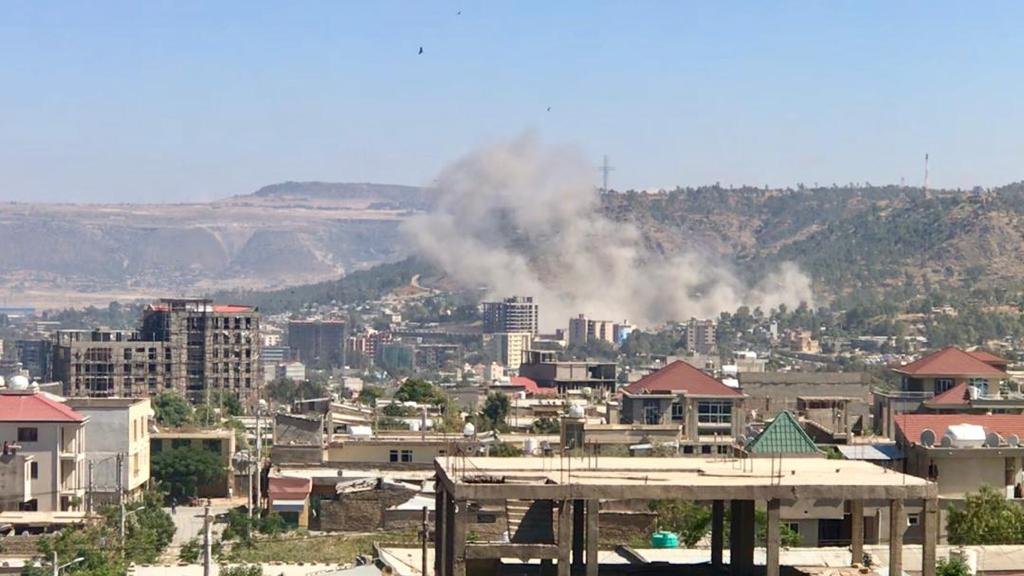
Verified developments, 22–24 September 2026
Horn of Africa
I · Horn of Africa
Tigray Forces Take an Airport, Ethiopia Edges Toward War
Three fronts are now active at once, and the national airline has already pulled out.
1. Ethiopia. Forces of the Tigray People’s Liberation Front seized Mekelle airport, normally under federal control, on 23 September, and clashed with government troops in the Afar towns of Abala and Erebti after federal forces attacked Tigray a day earlier using drones and heavy artillery. The Tigray regional government said it had ordered its fighters into a “defensive war.” Fighting also spread into Amhara, where TPLF units coordinated with the Fano militia — one of six other armed groups that joined the TPLF on 20 September in the seven-group Ethiopian Peoples’ Forces Alliance for Survival against Prime Minister Abiy Ahmed’s government. Ethiopian Airlines suspended flights to Mekelle, Axum and Shire. — Africanews; Euronews; France24, 23 September; NPR, 24 September.
2. African Union. AU Commission chairperson Mahmoud Ali Youssouf called for restraint and “immediate de-escalation,” warning the airport seizure and renewed clashes risk reversing the gains of Ethiopia’s 2022 Pretoria peace agreement. — wire reporting via allAfrica and AP-affiliated outlets, 23 September.
Middle East
II · Middle East
One Hill in Taiz, a War’s Bloodiest Month
Government forces took a hilltop this week; the toll behind it tells the bigger story.
1. Yemen / Taiz. Forces of Yemen’s Saudi-backed Presidential Leadership Council said on 23 September they had taken full control of Mount Qarfan in Taiz governorate, contested since the Houthi movement opened a new offensive against the internationally recognized government on 3 September. The Taiz military axis’s chief of staff said troops killed five Houthi fighters and wounded 20 more taking the hill. The World Health Organization has recorded 674 people killed and almost 3,000 injured in renewed Yemeni fighting since 6 August, including 164 deaths and 516 injuries in the 13–18 September window alone. — Al Jazeera, 23 September; World Health Organization figures cited by Al Jazeera.
Great Powers
III · Great Powers
Trump Threatens “Annihilation,” Pezeshkian Answers With Photos
A UN General Assembly exchange between Washington and Tehran got personal, fast.
1. United States / Iran. President Donald Trump told the UN General Assembly on 22 September that he faces a “big decision”: a deal that lets Iran “rebuild and create a far greater country than it ever was before,” or, in his words, to “annihilate the Islamic Republic and do it quickly, never giving them a chance to kill and destroy people and countries again.” Trump said he expects a deal only after the US midterm elections in November, and disclosed that US envoys had already met Iranian officials for three hours on the sidelines. — ABC News; NBC News; Axios, 22 September.
2. Iran’s response. Iranian President Masoud Pezeshkian addressed the same General Assembly on 23 September, saying “we will not bow our heads” and that Iran does not “seek anyone’s permission” to defend itself. Pezeshkian held up photographs of more than 150 schoolchildren he said were killed in the war’s first days, arguing that such language “goes against the very essence, charter and spirit of the United Nations.” — Washington Post; CBS News; NBC News; The Hill, 23 September.
Consequences
IV · Consequences & Outlook for the Horn
What Today’s Developments Could Mean
1. Ethiopia’s Bandwidth. An Ethiopian government fighting a seven-group coalition on three fronts at once — Tigray, Afar and Amhara — has less capacity to press Eritrea over Assab or Egypt over the Nile dam; near-term, this narrows Abiy Ahmed’s external options rather than widening them.
2. The Airline Signal. Ethiopian Airlines’ suspension of Mekelle, Axum and Shire is an early economic signal, not just a security one — a prolonged shutdown would strain an economy still recovering from the 2020–2022 war.
3. Djibouti’s Exposure. Fighting reaching Afar puts the Addis Ababa–Djibouti corridor — landlocked Ethiopia’s single busiest trade route — within range for the first time this week; any real interruption would show up in Djibouti’s port revenue within weeks.
4. Washington’s Distraction. A White House fixed on an “annihilate or deal” choice with Iran has little bandwidth left to mediate Ethiopia’s internal war even if asked — that role now falls to the African Union and IGAD, not Washington, at least until after November’s US midterms.
5. Mitigation. Djibouti’s clearest protection is what it has already been doing since the last Tigray war — diversifying port revenue toward Somaliland’s Berbera corridor and Gulf-state investment rather than relying on the Addis Ababa–Djibouti rail alone; a second Afar-region flashpoint is the moment to accelerate that shift, not wait it out.
Outlook: the Horn’s central risk has moved in one week from diplomatic to physical — three active fronts, an occupied airport and a suspended airline. The direction is toward escalation, not away from it.
Red Sea Horn tracks security, politics and trade across the Red Sea corridor and the Horn of Africa. Every claim above is traced to a named outlet; where a claim comes from only one side of a dispute, we say so.
By Abdinasir Hassan Timoweyne, Founder and Director of the Nexa Centre.