
Horn of Africa Weekly Update · Issue No. 12
Somaliland’s Biggest Door Yet, Abiy’s Win over the TPLF, and the Eritrea Standoff
Nexa Insight · Regional Analysis · Horn of Africa Weekly Update
Reference: NRTC/HAWU/2026-12 | Coverage: 12–15 October 2026, with 9–11 October background where it explains the week | Published: 15 October 2026
This week
Three stories decided this week in the Horn. First, Somaliland’s diplomacy won its biggest opening yet: President Donald Trump told a rally in Ohio that Somaliland is “a totally different country” from Somalia. Second, Prime Minister Abiy Ahmed’s forces beat the Tigray People’s Liberation Front (TPLF) as an army, taking every major town in Tigray. That gives Abiy more room than at any time since 2018. Third, Ethiopia and Eritrea traded letters at the UN that read like legal preparation for war, while Eritrean troops appeared to pull back. This issue asks the same question of all three: who gained, who paid, and what decides the next move.
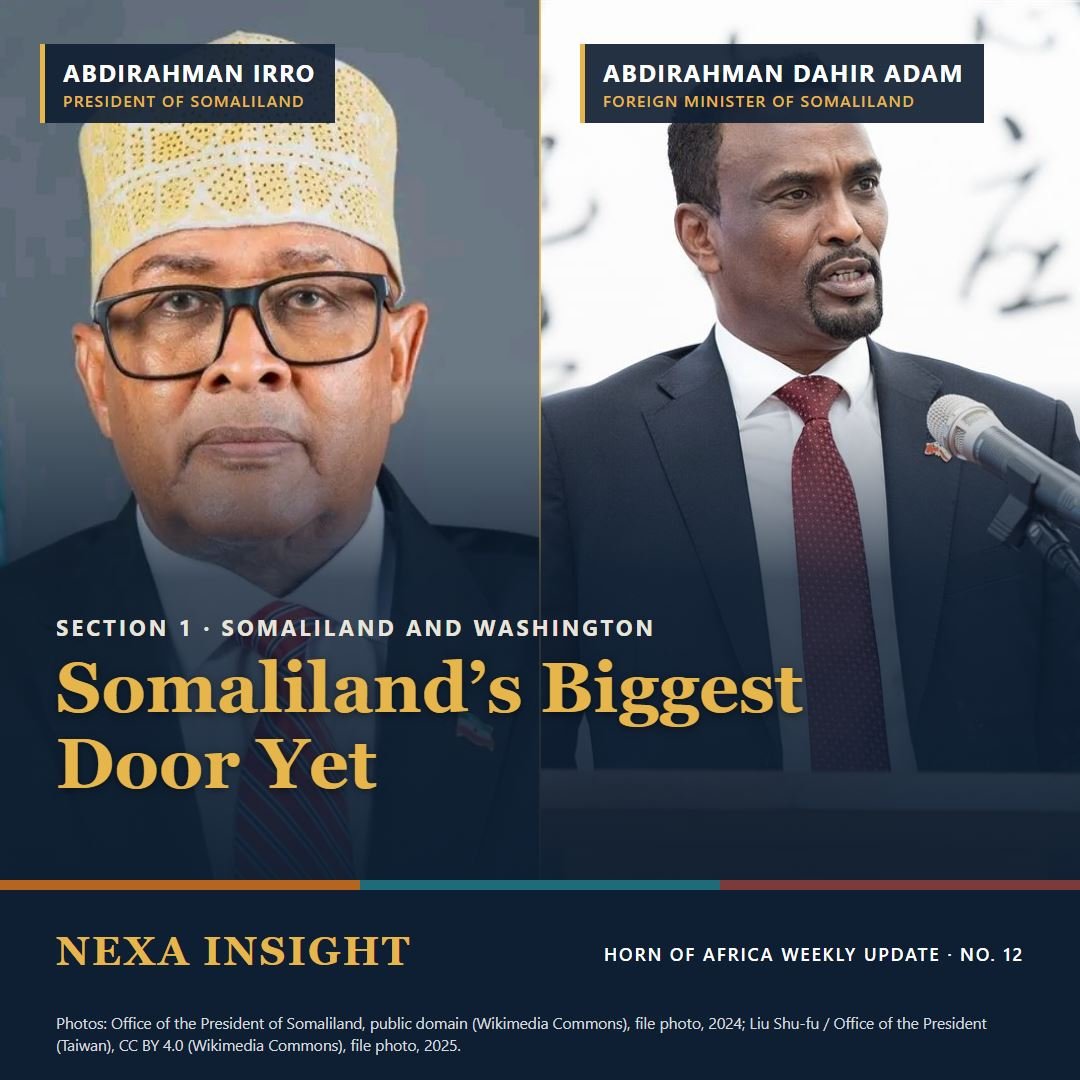
1. Somaliland’s diplomacy opens its biggest door yet: Trump separates Somaliland from Somalia
KEY EVENTS THIS WEEK
- 11 Oct: President Irro, in an interview with Breitbart News, asks Trump to recognise Somaliland and offers Berbera, security and maritime cooperation.
- 12 Oct: At a rally in Ohio, Trump calls Somaliland “a totally different country” from Somalia.
- 13 Oct: Somaliland’s government and Foreign Minister Abdirahman Dahir Adam welcome the remarks; crowds celebrate in Hargeisa; Kulmiye calls for formal recognition.
- 13 Oct: Somalia’s state minister for foreign affairs says a “Foreign Ministry statement” against the remarks is fake; no official reply from Mogadishu by 15 Oct.
What happened: Trump’s exact words in Youngstown, Ohio, were: “I call it Somalia land, not Somaliland, because actually it’s a totally different country” (allAfrica, citing Horn Diplomat). Somaliland’s government said they “underscore Somaliland’s distinct identity and its separate political reality” (Middle East Eye). The remarks followed weeks of Somaliland diplomacy in the United States, starting with President Irro’s visit to Washington in September (Dawan) and his offer of Berbera, counter-terrorism and maritime cooperation, and, according to bne IntelliNews and Africa Confidential, minerals.
Analysis: This is the biggest diplomatic opening Somaliland has had in Washington since it restored its independence in 1991. No US president had spoken of Somaliland this way before. Now the president himself calls it “a totally different country.” That shift did not happen by chance. It follows a deliberate campaign by Somaliland’s president and foreign ministry that spoke the language this White House understands: a partnership with something to offer. Somaliland brings a strategic port at Berbera on the Gulf of Aden, a long record of peaceful elections and transfers of power, minerals, and a coastline facing Yemen, where Houthi missiles hit Riyadh only days ago. For a US government that judges partners by what they bring, that is a strong hand. In international politics, recognition follows interest, not justice alone. Hargeisa’s leaders have built their case on that rule, and it is the rule great powers actually use.
The words also change the balance of the argument. Somaliland’s case rests on its own history: separate rule as British Somaliland, its independence on 26 June 1960, and the colonial-era borders it inherited. When the US president himself draws the line between “Somaliland” and “Somalia,” that case gains a weight in Washington it has never had. The next step Hargeisa is now pressing for is the formal act of recognition, and its diplomats now have the president’s own words to build on.
Effects: For Somaliland, morale and bargaining power rise sharply, and its foreign ministry gains a strong argument in every capital it visits. For Somalia, the remarks add pressure just as it enters an election year, with votes set for April and May 2027. For Ethiopia, which signed a port memorandum with Somaliland in January 2024 and still wants a sea outlet, a warmer US attitude toward Hargeisa offers a peaceful route to the sea, away from Assab. For Egypt’s four-way grouping with Eritrea, Sudan and Somalia, which opposes any change to Somalia’s borders, US interest in Berbera is an unwelcome shift.
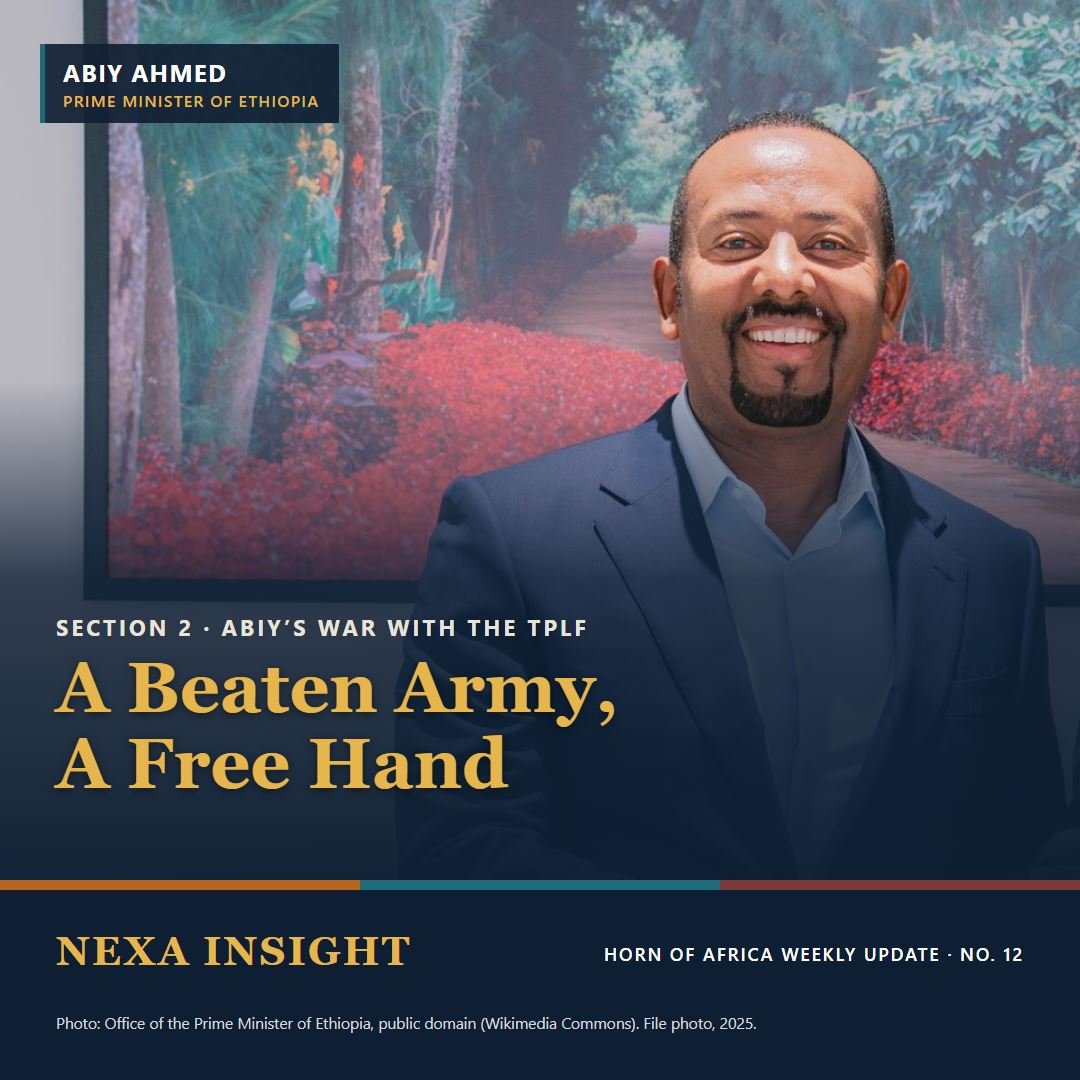
2. Abiy’s war with the TPLF: a beaten army, a free hand, and the limits of victory
KEY EVENTS THIS WEEK
- 10 Oct: Abiy names former TPLF leader Getachew Reda his East Africa adviser with ministerial rank.
- 11 Oct: Flights to Mekelle resume; Getachew arrives, declares the war over and announces a six-month federal command post for Tigray.
- 14 Oct: The TPLF claims it retook Abiy Addi in central Tigray (unverified); Gambella is put under curfew after deadly attacks.
- 14 Oct: The Finance Ministry starts a ten-week plan to borrow about 134 billion birr through treasury bills, a sign of the war’s cost.
- 15 Oct: Adwa, Axum, Adigrat and Zalambessa reported under federal control; the TPLF vows a counter-offensive.
What happened: Since taking Mekelle on 3–4 October, federal forces and the allied Tigray Peace Force have taken every major town in Tigray (Wazema Radio). The pro-government militia says the TPLF can no longer “stand and fight” (AFP, unverified); the TPLF says its forces are intact and preparing a counter-offensive (Wazema Radio). Abiy’s answer is political as well as military: he brought Getachew Reda, once the TPLF’s public voice, into his government (Ethiopian News Agency) and plans a six-month military-led administration for Tigray (Kulu Media, via The Rio Times). Human Rights Watch reported civilian deaths from shelling in southern Tigray (AP).
Analysis — the TPLF’s defeat: This is a real defeat. The TPLF started this round on 23 September with large offensives into Afar and Amhara. Within three weeks it had lost every major town it held, including its capital and its holy city of Axum. Its bet seems to have been that Eritrean help and a wider anti-Abiy alliance would carry it. Neither came in time. But the TPLF has lost cities before and come back, as in 2021. The difference now is political: Tigray is split. Tigrayans in the Tigray Peace Force fought on Addis Ababa’s side, and Getachew Reda, once the TPLF’s public voice, sits in Abiy’s cabinet. The federal plan is to isolate the old leadership around Debretsion Gebremichael and rule Tigray through Tigrayans who accept Addis Ababa’s terms. If that works, the TPLF shrinks from a party-state into an armed faction. If the six-month command post becomes a harsh occupation, it will rebuild the TPLF’s support faster than any counter-attack could. In the Horn, armed movements survive defeat when they keep an outside patron and a safe border. The TPLF’s fate now depends less on its own fighters than on whether Asmara keeps the door open.
Analysis — the future of Abiy’s rule: Abiy was re-elected prime minister on 5 October, and his rule now rests on three supports: an army that has just beaten its oldest rival, the Prosperity Party’s control of the state, and a national story — the promise of a sea outlet. Each has a cost. The army is fighting on several fronts at once: Tigray, the Fano militias in Amhara, insurgents in Oromia, and now Gambella. The party is strong in Addis Ababa but thin in the countryside. And the sea-outlet promise points straight at Eritrea’s port of Assab. So the future of his rule depends less on winning battles — he has shown he can — than on whether he can stop fighting them. In the best case, he settles Tigray through co-opted Tigrayan leaders, cools the Eritrea dispute, and turns to the economy. In the middle case, Ethiopia lives with low-level insurgencies for years and debt crowds out growth. In the worst case, the sea goal draws him into a war with Eritrea that Egypt and Sudan help Asmara sustain. A government borrowing 134 billion birr in ten weeks at home cannot easily pay for a long war abroad; that is the strongest reason for Abiy to bank this win.
Effects: For security, expect a shift from front lines to ambushes, drone strikes and raids. For the people of Tigray, where about 500,000 civilians died in the 2020–22 war according to Ghent University researchers cited by the AP, the tests are aid access, phone and internet links, and the return of the displaced. For politics, Abiy has fewer rivals inside the system than ever — fewer checks, but also no one else to blame if things go wrong.
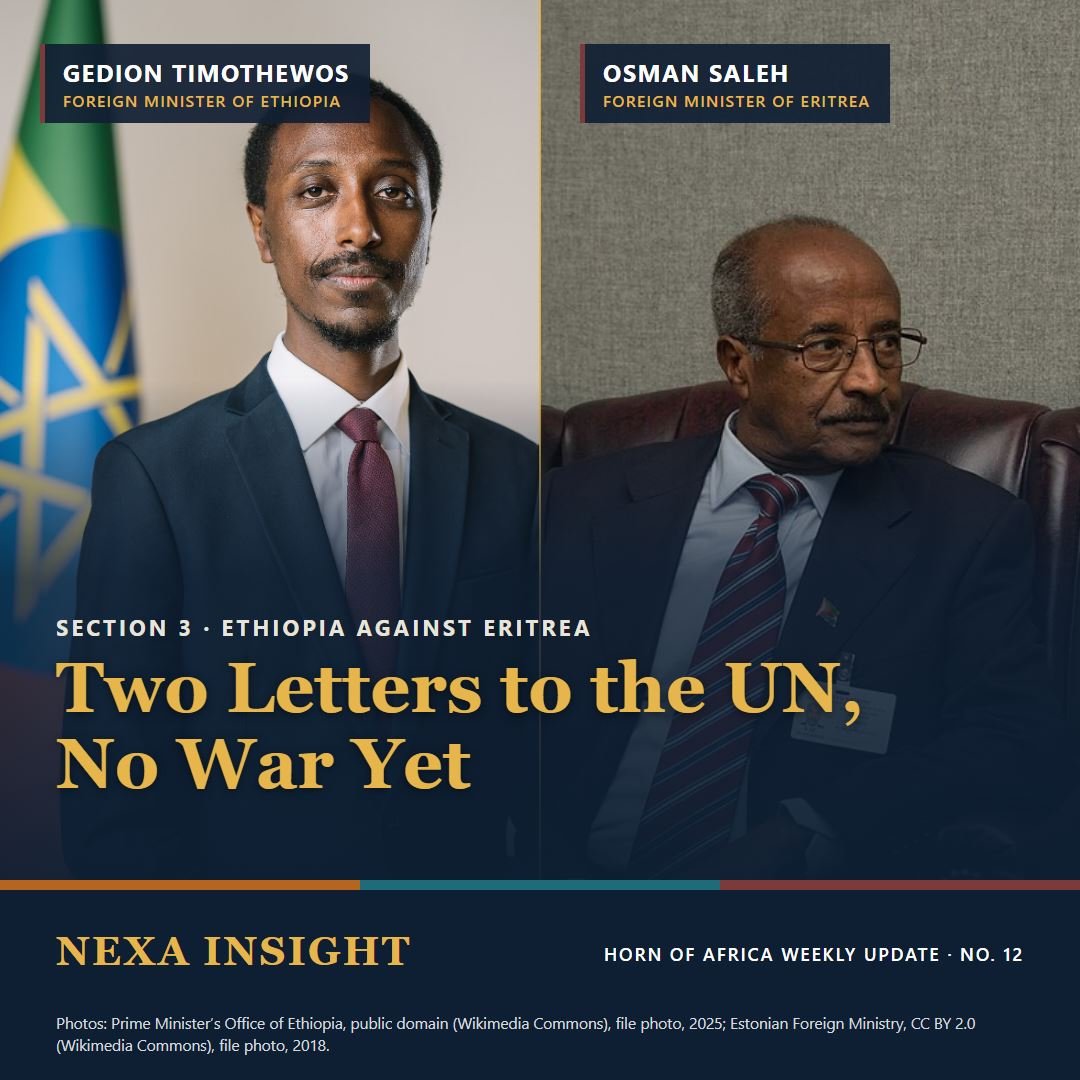
3. Ethiopia against Eritrea: two letters to the UN and a war still avoided
KEY EVENTS THIS WEEK
- 9 Oct: Ethiopia writes to the UN Security Council, says Eritrean troops pushed 60 km into Tigray, and invokes self-defence.
- 10 Oct: Eritrea replies, calls it a “declaration of war” and asks the Council for deterrent measures.
- 12 Oct: Eritrean soldiers leave the town of Fatsi near the border; federal forces move in.
- 12–13 Oct: International Crisis Group warns the two states are “perilously close to all-out war.”
- 14 Oct: US Secretary of State Marco Rubio calls Abiy, urges de-escalation and respect for neighbours’ borders.
What happened: The two governments took their fight to the UN Security Council. Ethiopia’s foreign minister, Gedion Timothewos, cited the right of self-defence (Capital Ethiopia; AP); Eritrea’s foreign minister, Osman Saleh, asked for action under Chapter VII — the part of the UN Charter that allows sanctions or force (Reuters). On the ground, a foreign security source told AFP that 5,000 to 8,000 Eritrean troops had been in Ethiopia and appeared to be pulling back; Eritrea denies its troops crossed. Washington’s message, in the State Department’s words, was “de-escalation by all sides” and a return to the 2018 peace framework.
Analysis: Both letters are legal positioning. Ethiopia’s self-defence language builds a case in advance, in case its forces cross the border. Eritrea’s Chapter VII request asks the world to label any such crossing as aggression. The reported Eritrean pullback, if confirmed, is the most important fact of the week. It suggests Asmara does not want to fight the Ethiopian army head-on to save the TPLF. Eritrea’s interest was never a TPLF victory; the two were enemies from 1998 to 2018. Its interest is a weak, divided Ethiopia that cannot threaten Assab. With the TPLF beaten, Asmara loses its proxy, but it also loses its reason to risk its own army. This is the old strategy of a small state next to a large one: keep the neighbour divided, avoid a direct fight it cannot win, and bring in outside backers — now Egypt — to raise the cost of any attack. Washington’s message cuts both ways: it supports Abiy against the TPLF but warns him against crossing into Eritrea.
Effects: For security, the risk now sits on the border itself — Zalambessa, Badme, Bure near Assab — and in drones and air space. For diplomacy, the Security Council has two formal letters before it but has not met on them as far as Nexa Insight could find. For the region, a pause is likely while both armies regroup; it is not a settlement.
Key points for regional decision-makers
- On Somaliland: Treat Trump’s words as the strongest opening Somaliland has had in Washington. Build on them with a clear offer — Berbera, maritime security, counter-terrorism, minerals — and keep the 1960 legal basis of the claim at the centre.
- On Abiy and the TPLF: Treat the TPLF as defeated as an army but not as a political force. Abiy’s position is the strongest since 2018; his limits are money and the number of fronts. A harsh occupation of Tigray is the TPLF’s best recruiter.
- On Ethiopia and Eritrea: Read the two UN letters as legal preparation for war, and the Eritrean pullback as a sign neither side wants it yet. A push toward Assab is the single decision most likely to undo Abiy’s gains.
Bottom line
Somaliland’s patient diplomacy has opened its biggest door in Washington, just as the balance of power in Ethiopia has shifted. Abiy Ahmed has beaten the TPLF as an army and now has a free hand at home. How he uses it will shape the Horn for years: a political deal in Tigray and calm with Eritrea, or a reach for Assab that turns a won civil war into a lost regional one. A peaceful route to the sea through Somaliland, now with warmer US attention, is the alternative. In the next issue we will track whether Washington turns Trump’s words into a formal step, whether the TPLF can mount any real counter-attack, and whether the Security Council acts on the two letters.
References
allAfrica, citing Horn Diplomat (2026). Somalia: Trump Calls Somaliland a ‘Totally Different Country’, 13 October. allafrica.com
allAfrica / Horn Diplomat (2026). Somaliland Welcomes Trump’s Remarks On Separate Status, 14 October. allafrica.com / horndiplomat.com
Middle East Eye (2026). Trump says Somaliland is its own country, but should change its name, 13 October. middleeasteye.net
Somaliland Chronicle (2026). Trump Calls Somaliland a “Totally Different Country,” Sparking Hope and Reviving Name-Change Debate, 13 October. somalilandchronicle.com
Somaliland Standard (2026). Kulmiye welcomes Trump’s remarks on Somaliland and calls for official recognition, October. somalilandstandard.com
Agenzia Nova (2026). Somaliland Foreign Minister thanks Trump for recognizing “our distinct status”, October. agenzianova.com
Breitbart News (2026). Celebrations Break Out in Somaliland After Trump Acknowledges It, 13 October. breitbart.com
Voice of Nigeria (2026). Somaliland Celebrates President Trump’s Remarks, Hopes for US Recognition, October. von.gov.ng
Dawan (2026). Document on Trump’s Alleged Somaliland Remarks is Fake, Somalia’s State Minister Says, 13 October. dawan.africa
Dawan (2026). Somaliland president departs for US in first visit since taking office, September. dawan.africa
bne IntelliNews (2026). Trump calls Somaliland ‘a totally different country’ as Hargeisa offers US mining rights in exchange for recognition, October. intellinews.com
Wazema Radio (2026). TPLF Vows Counteroffensive as Government Forces Consolidate Control of Major Tigray Towns, 15 October. wazema.substack.com
Africanews, with AFP (2026). Eritrean forces suffer ‘heavy losses’ in Tigray, Ethiopian militia says, 15 October. africanews.com
Dawan (2026). Ethiopia: TPLF Says It Retook Abiy Addi in Central Tigray, 15 October. dawan.africa
The Rio Times (2026). Ethiopia Resumes Mekelle Flights as Officials Fly In (citing Ethiopian News Agency, Kulu Media and TBS), 12 October. riotimesonline.com
Associated Press, via WRAL and The Washington Post (2026). Rubio urges restraint over Ethiopia-Eritrea tensions as rights group reports civilians killed, 15 October. wral.com / washingtonpost.com
US Department of State (2026). Secretary Rubio’s Call with Ethiopian Prime Minister Abiy, 14 October. state.gov / et.usembassy.gov
International Crisis Group (2026). Pulling Ethiopia and Eritrea Back from the Brink (as republished by Modern Ghana), 13 October. crisisgroup.org / modernghana.com
Reuters, via ThePrint and A News (2026). Eritrea asks UN to intervene in standoff with Ethiopia, 10 October. theprint.in / anews.com.tr
Capital Ethiopia (2026). Report on Ethiopia’s Article 51 letter to the UN Security Council, 11 October. capitalethiopia.com
Al Jazeera (2026). Ethiopian government forces seize Tigray capital Mekelle as TPLF withdraws, 4 October. aljazeera.com
Abdinasir Hassan Timoweyne is Founder and Director of the Nexa Centre and Senior Lecturer in International Relations at New Generation University. He is the author of several published articles on Horn of Africa and Middle East politics.